
24th Sunday after Pentecost, Year A
Nov. 8, 2026
Matthew 25:1-13
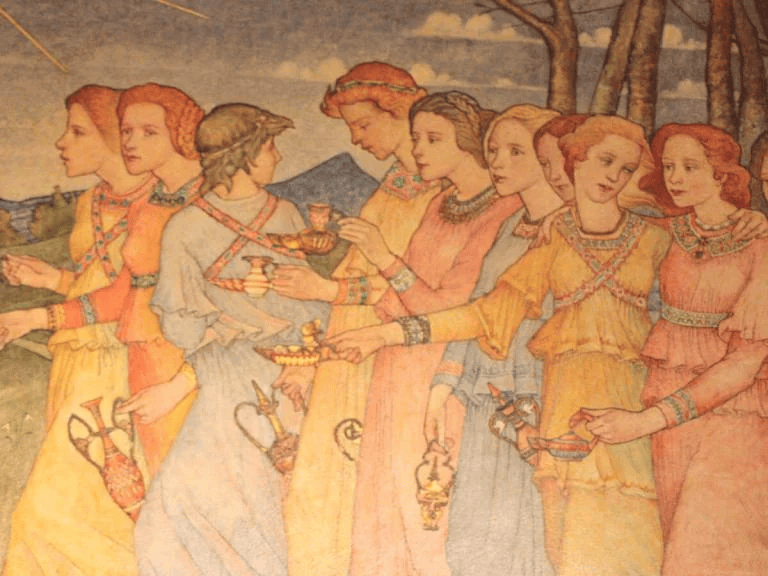
Well, if you were listening to or reading along with the Gospel today and thought, that’s weird, you were not wrong. It’s one of those frequent times in the Gospel when we end up with the disciples saying, “Come again, Jesus?” This parable of the bridesmaids or young maidens is one of the most difficult parables to understand, especially with what we’ve been taught was the conventional interpretation. I believe that when Jesus appears to be intentionally oblique that he is signaling there is more here than what you think it means. Jesus likes us to wrestle with it, think through, work through it, until we find the depth of the meaning of the lesson. So, let’s dig deep into this rather disturbing parable.
To start with, I wouldn’t be too quick to point fingers at the so-called “foolish” maidens (a better translation than virgins). It’s not like they didn’t come prepared. They brought what they thought was needed. The bridegroom was supposed to arrive at a certain time. It’s the bridegroom who’s late, for crying out loud!
According to the customs during the first century, the groom would have arrived at the wedding celebration with the bride, not as the text seems to imply, to get the bride. The bridesmaids would have been her friends and would be awaiting her return with the groom. Many scholars agree that the original parable likely included the bride and the bridegroom arriving late together.1 That the young maidens were not there when the bridal couple finally did arrive would have been seen as a betrayal of significant proportion.
Perhaps it wasn’t so much that these five, who were considered foolish, erred in not bringing extra oil. It wasn’t like they weren’t prepared. They had oil in their lamps and were prepared for the bride and bridegroom to arrive at the expected hour.
Maybe the error that the foolish five made was in leaving. I mean, there was no 24 hour corner store in those days to quickly pick up some extra oil. They would have had to go home and wait until morning. But what would have happened, I wonder, had the bridesmaids simply continued to wait, with sputtering lamps and dwindling lights? What if they had simply waited in the darkness of the night?
They would have been there when the wedding couple arrived. The bride and bridegroom would have welcomed their friends who had faithfully waited long past the appointed hour and would have been more likely to be delighted in their perseverance and less worried about the state of their lamps. It would have taken so much faith, though, to have waited in that frailty of the midnight hour.
So I wonder if the message is that no matter how thin our light, no matter how dark the night, we wait, not seeking to be anything other than present right where we are. Not immediately rushing into fix-it mode, but sitting with it. We trust that in the end, when the light of the bridegroom arrives, it won’t matter whether our tiny oil lamps are flickering still or extinguished completely. Rather the light of the bridegroom will be enough for all, to illuminate the beauty of the darkness and to bring us, in joy, to the midnight celebration.2
Let’s look at the problematic parts of the parable a bit more closely. The parts that don’t seem to align with what we’ve already known about what Jesus taught. You see, we too often look at these stories and interpret them as either-or choices. That there are only two options, one good, one bad. Jesus frequently turns that notion on its head and suggests there are other ways to see the dilemma beyond the this is good and that is bad dichotomy. Are the foolish maidens really bad and the wise ones good? What are we to do with those wise ones who couldn’t spare an ounce of oil, those wise ones who chose their needs over the needs of others? What are we to do with them?
This kind of selfishness is not exalted anywhere else in the bible, from what I’ve read. We cannot share with you because we might not have enough for ourselves. That does not align with Jesus’ message nor with how the Kingdom of God works.
The wise and foolish both have the same problem. They are operating out of a premise of scarcity and fear, using those misguided emotions to direct their choices. Neither trusts the love the bridegroom has for his friends. Neither trusts that the bridegroom will embrace all regardless of whether they walk in light or walk in darkness. Neither have taken to heart Psalm 139 that points out that dark and light are both the same to God. The midday sun is as bright as the night!
So those who are deemed wise actually try to break up the bridal party by telling the other five to leave and go get their own oil. By the time they get back, they are ostracized, left out in the cold. They weren’t there so the bride and groom may have thought their friends had abandoned them, turned their backs on them, and left the party. Or they had just given up because of the delay and gone home. They wouldn’t have known that their friends were actually out there trying to find more oil.
You see, I don’t think this parable is about the return of Christ. It does not hold together from that perspective, even though it has become more often the traditional explanation. We frequently like being the judges and sending others to a fiery pit and jump to those conclusions. It makes us feel superior.
Remember that Matthew was a book written shortly after the destruction of Jerusalem at a time when Jewish institutional leaders were understandably licking their wounds and retrenching. They were clamping down on rebellious and heretical strands of Judaism, including, of course, the Jesus movement. They were drawing lines of who was in and who was out. In other words, this is a story about real life, about religious leaders who literally shut the doors of the synagogue to the Jesus movement.
Once again, we have to put this parable in context. This is one parable of three you will hear before Advent (Bridesmaids, Talents, Sheep & Goats), where at the end Jesus explains to his listeners who were the truly foolish and who were the truly wise in each of his parables.
In the end, Jesus says, those on their way to heaven will be decided by what they gave away, whether they fed the poor, welcomed the stranger, clothed the naked, visited the sick and imprisoned. Whether they shared what they had. Whether they shared their oil.
If they hoarded what they had, they, of course, already enjoyed their reward. It was comforting, of course, but temporary. The wise on earth had their wedding feast on earth.
But that is NOT how it is and will be in the Kingdom of Heaven. Remember the Beatitudes from last week and who were the unlikely blessed ones.
Perhaps you can find yourself in this story, because I can see that I’ve probably been each of this parable’s characters. I’ve been the foolish whose lamp has run out. I’ve been the wise who feared sharing and losing what I had. I’ve been the wounded bridegroom who refused to let people in.
I think what we can learn from this lesson is that if you find you are the foolish who showed up with not enough fuel to keep you going, remember to wait in the darkness. Don’t run from it. It is a holy place and God will meet you there.
If you find yourself feeling like the wise bridesmaids, remember to share what you have, even if it scares you. Don’t trade temporary comfort for lasting and beloved community. The chance to give of yourself is a holy place and God will meet you there.
If you find yourself feeling like the bridegroom, remember to open wide the door to the banquet feast. Don’t let hurt feelings and fear insulate you from others. Welcoming those who have made mistakes and who walk in darkness is a holy place. God will meet you there.3
While the wise maidens had more oil which they weren’t willing to share, the one thing that is shared nevertheless is light, just by the sheer nature of light. And sometimes faithfully waiting in the dark is what we are asked to do. To stay present at all times.
God meets us when we are foolish and when we are wise. So let’s stay present, remain a beloved community, and go to the feast together.

