
21st Sunday after Pentecost, Year A
Oct. 18, 2026
Matthew 22:15-22
Amy Frykholm, [one of the editors of Journey with Jesus], tells a story about her husband, Peter, when he was in a library in Bamako, Mali. A woman came around to serve lunch to everyone. When she brought a plate of chicken stew and rice to him, he hesitated. He hadn’t ordered lunch. He wasn’t an employee or a visiting dignitary. When he tried to tell the woman that he didn’t think he was included in the lunch, she looked at him quizzically. “All food belongs to God,” she said, setting down the plate next to him.
All food belongs to God — that is, everything that nourishes us, everything that keeps us alive, every resource on the entire earth is God’s. As Psalm 24 says, “The earth is the Lord’s and everything in it.” This is one of the best examples of what God’s economy looks like. God’s coinage is made of chicken and rice, where everyone has a seat at the table.
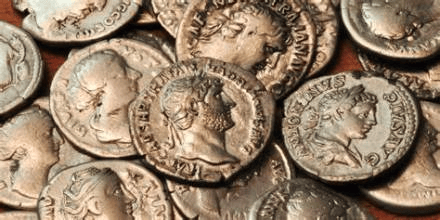
Long before mass media, television, or the internet, coins traveled everywhere across an empire. Putting a king, queen, or emperor’s face on them ensured that every person using money was constantly reminded of who was in charge. Early leaders—starting famously with Alexander the Great and Julius Caesar—used coin portraits to cement their power, project strength, and show divine or political right to rule. This practice continues today, although many countries do not put faces on their coins.
In our gospel reading today, Jesus is asked a question which was designed to get him in trouble no matter how he answered it. The first opening sentences prepare us for the trap. “The Pharisees went and plotted to entrap Jesus in what he said. So they sent their disciples to him, along with the Herodians.” These particular Pharisees sent their disciples and their allies who were loyal to Herod so as to avoid a direct encounter with Jesus. He had already embarrassed the Pharisees publicly, which they wanted to avoid this time, but also their goal was to have him arrested and killed. Set him up for blasphemy or set him up for saying something subversive against the government and they have him.
And that is indeed the kind of question they ask him. “Teacher, we know that you are sincere, and teach the way of God in accordance with truth, and show deference to no one; for you do not regard people with partiality.” Nice way to butter him up, but a little too obvious. Jesus knows what they are up to. If they honestly respected him as a teacher, they would not be trying to trap or oppose him. No where else in the Gospel do they give praise to Jesus in such a way.
“Tell us, then, what you think. Is it lawful to pay taxes to the emperor, or not?” “Tell us,” demands an answer from Jesus. He has used that phrase on them before so now they employ the same strategy. “Tell us what is lawful.” A question about what is lawful is bound to bring controversy. If Jesus speaks against paying tribute to the empire, then he is attacking Rome’s sovereignty. If he encourages payment, then he appears to be a collaborator and loses his credibility as a prophet. It’s a futile trap because Jesus has already voiced that he will die at the hands of the Romans. But you see the conundrum they have tried to put him in.
So, he calls them out on it. “Why are you putting me to the test, you hypocrites?” You can almost hear the heavy sigh. “Show me the coin used for the tax.” And so they bring him a denarius for a little show and tell. It had to be a denarius because the tribute that the Judeans had to pay to Rome had to be paid with Roman money. This coin probably bore the head of Tiberius but a few decades later when Vespasian has the Temple burned to the ground, it will include his head with the added inscription, JUDEA CAPTA, which were commemorative coins celebrating the suppression of the Jews.
Jesus answers them with, “Give therefore to the emperor the things that are the emperor’s, and to God the things that are God’s.” When they heard this, they were amazed; and they left him and went away. Jesus upholds paying the tribute, as he does earlier in Matthew’s Gospel when challenged to pay the taxes. But the Pharisee’s disciples and the Herodians are amazed because they actually get the meaning of what Jesus was saying. A message that has too often gone over our modern heads.
Jesus is not saying there are two separate realms and God’s realm doesn’t mix with these matters of government. In fact, quite the opposite. Jesus proclaims the Kingdom of God is here and now everywhere he goes, and proclaims that God’s empire will continue and will see the fall of the Roman Empire and does not advocate unquestioning loyalty to Rome. Jesus’ teaching here is that a tribute can be paid without that payment being a sign of support of Rome’s empire. Just give back to them what they have created.
What is God’s includes what the Romans believe is theirs, yet all things belong to God, all things that nourish. These payments are made within the context of God’s far greater economy and authority. He is reminding all those that listen, not just those sent to trap him, that ultimate loyalty belongs to God. Disciples, who live in God’s world and in Rome’s world, and for us disciples who live in North America world, are challenged to live faithfully in “both” until God’s empire is finally established over all. I say “both” in quotes because we are permanent citizens of God’s realm, transients temporarily calling this country home. The Son of God is Jesus the Christ, not the Emperor, who also claimed the title, Son of God. God’s house is not some place we will go to in the future like a retirement home, but here and now and always, even in the midst of an empire that believes itself to have ultimate authority. We live in two places at once, and only one is our permanent home.
Elsewhere in the scriptures Jesus tells his disciples there is a dwelling place that he has prepared for us–”If it were not so, I would not have told you.” And this dwelling place is here now, and also not yet. The dwelling place is Christ and we are the Body of Christ. And in it there is a table, and while we pay our earthly taxes, we are to live in God’s economy, setting a table where we acknowledge that all food belongs to God, therefore all are to pull up a chair and eat. As above, so below. Call it our heavenly taxes, if you will. What we have been given, all of it, is God’s. Our heavenly tax is to make sure others are cared for as well.
Ours is not to question if one deserves to eat, or one deserves to share in what we have, we are never the judges of that. We have been mandated to give a cup of cold water and to feed the hungry. Full stop. Even the Levitical law, as well as Jesus’ commandments, tell us to provide shelter and care for those who visit a foreign land. Both old and new testament warn that we will be judged on how we treat the stranger.
Is not paying our “taxes” to God for what is God’s anyway, as subversive of an act as if we did not pay taxes to the IRS? Maybe we grumble about it, but we pay it or we incur a penalty. God asks us to give freely, on the honor system. He doesn’t send us a bill, he says give to Caesar what is Caesar’s but to God what is God’s. Do we hold this instruction as having as much, if not more, significance? How did we end up thinking we could hoard the things that ultimately belong to God?
Everything that nourishes belongs to God. How glorious it would be if we, much like the cook that day in Mali, were so immersed in God’s kingdom, God’s economy of abundance and lived like we believed it, that when we prepared a dinner, we made sure everyone around us got a plate. Regardless if they were one of us, regardless if they were from this country, regardless of any difference. Rich and poor, old and young, black, brown, or white. How glorious it would be if Christians were known for their love, invited people to share in the generosity of Christ, and there was always an extra chair at the table.

