
20th Sunday after Pentecost, Year A
Oct. 11,2026
Philippians 4:1-9
On April 3, 1968, less than 24 hours before he was assassinated, Martin Luther King, Jr. spoke these words at the end of his last speech he would ever give:
“Well, I don’t know what will happen now; we’ve got some difficult days ahead.
I just want to do God’s will.
And He’s allowed me to go up to the mountain. And I’ve looked over, and I’ve seen the Promised Land.
I may not get there with you. But I want you to know tonight, that we, as a people, will get to the Promised Land.
And so I’m happy tonight; I’m not worried about anything; I’m not fearing any man. Mine eyes have seen the glory of the coming of the Lord.”
I could not help but think of that speech when I read Paul’s letter to the Philippians this week. Writing from prison to his cherished friends in Philippi, Paul’s life hangs in the balance for the sake of living out the Gospel of Jesus Christ. He does not know what lies before him. Yet, he writes to the church in Philippi, “My brothers and sisters, whom I love and long for, my joy and crown, stand firm in the Lord in this way, my beloved…Rejoice in the Lord always; again I will say, Rejoice…The Lord is near. Do not worry about anything,” That kind of faith from both of these men in the face of their impending death is astounding.
Paul writes this encouragement to the church in Philippi. Now the city of Philippi was “the way through between Europe and Asia, like a gateway. ‘ It was therefore a place where merchants traveled, people of every race, nationality, religion, and culture came through. It was this route from the east that brought Paul to found the first Christian group in Europe there. Phillippi was first a Greek city, but Marc Antony, and later Octvaius, made it a Roman colony for their retired non-Roman veterans which made them Roman citizens with full legal rights, free from taxation. A rare privilege.
The Philippian church was very dear to Paul. When he and his traveling companions, Silas, Luke, and Timothy, arrived, they wanted to go pray. They discovered there was no synagogue in Philippi, so they went down to a place of prayer outside the city gate by the river. There they met a woman by the name of Lydia, a wealthy businesswoman, and several other women. They all started talking about where they’d come from and why they were there, and Paul and his companions shared the Gospel with these women. And this astute businesswoman, Lydia, believed what she heard and she and her whole household were baptized. I got to sit by that river a couple of years ago and dip my feet in the cool water where she was baptized.
So that’s how this church came into being in Europe, through Lydia, and led by women such as Euodia and Syntyche, alongside men such as Clement and others. Once Paul got out of prison for ruining the source of profit for a slave girl’s owners, by freeing her from a demon that was annoying Paul, he visited Lydia again and I’m sure they must have discussed the future of the gathering that met in her home and the work they were to continue to build as a Christian community. Paul and Silas were urged to leave for their own safety but promised to return soon.
It is clear in this letter to his friends and coworkers in Philippi that the people that made up the Christian community there were very dear to him. Paul truly loved them and was proud of the church that continued there. The community formed here grew into a very generous and supportive congregation that later aided Paul’s ministry.
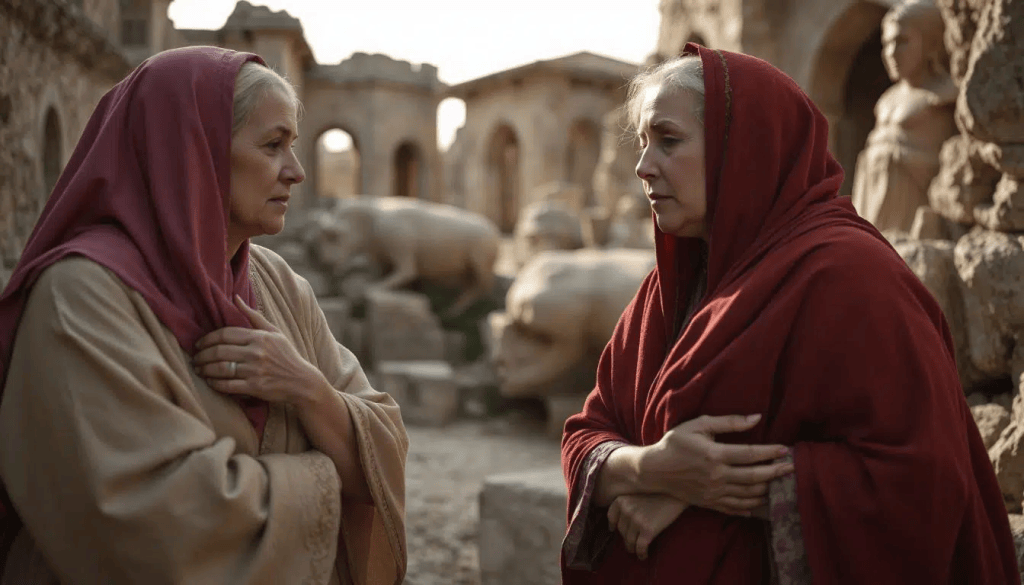
Paul writes them a letter years later, knowing that contention and disagreement can rise up in a city where some are full citizens and others are not, in a very difficult political and religious environment. There are seasons of maturing that often tax the endurance of even the most devoted individuals and communities in an environment where the poor were taxed more than the rich, where slaves were sold at the crossroads, where non-Roman citizens had no rights, where the barbaric practice of the Roman Empire of public executions drew blood-thirsty crowds, and the hungry were denied their basic needs. It doesn’t sound much different than our world today. And I think that is why this letter is so relevant to us now.
Paul wrote this letter to his friends in Philippi to encourage them and direct them in how one handles times fraught with injustice and violence, power and greed. He also knew his own life was at risk and he didn’t want them to worry. He wanted to equip them to carry forth the work of the Gospel and refresh their spirits and to never tire in following the Way of Jesus–even though it was entirely counter to the culture they lived in.
Paul encourages everyone to stand firm in what is right and good. To not be swayed by the evils they see occurring around them. He encourages his loyal companion, who may have been Epaphroditus, to support Euodia and Syntyche. They may have been feeling the weight of their call like ministry coordinators in a church often feel. And he wants his friends to be of one mind in the Lord, to share the burden, share the encouragement that is needed to keep the work going.
When the work of the church is to stand for whatever is true, whatever is honorable, whatever is just, whatever is pure, whatever is pleasing, whatever is commendable, and whatever is worthy of praise, that was hard to do then and it’s hard to do now. So Paul reminds them where their power lies. Rejoice in the Lord, always. Again I say rejoice! Let your gentleness be known to everyone. The Lord is near you! You do not stand in the gap alone. Without cultivating this ability to rejoice in the face of injustice, you will give up and just turn a blind eye to the needs of the world, you will not speak when there is wrong being played out in front of you.
Our faith is work in action and like our physical bodies, it has to be exercised to stay healthy. Think about these things, Paul says emphatically. He is telling his church that they have to have a consistent practice of prayer or meditation and “keep on doing the things that you have learned and received and heard and seen in me, and the God of peace will be with you.” Keep on doing these things. Rejoice! When we keep on doing these things we stay strong for those who are weak, we stay hopeful for those who have no hope.
Do not worry about anything, but in everything by prayer and supplication with thanksgiving let your requests be made known to God. And the peace of God, which surpasses all understanding, will guard your hearts and your minds in Christ Jesus. In case that just sounds too pollyanna for you, I’m here to tell you it is daily hard work! Paul encourages us to keep on doing these things because he knows, and every spiritual teacher on prayer and meditation will tell you, that it is by daily repetition that “these things” get ingrained in you. They become a part of your cellular structure and they change your brain. Do you never have a doubt again, do you never fear or worry or no longer have the strength to carry on some days? No!
And that’s why we live our faith out together and help each other, like Paul tells the community to help Euodia and Syntyche. Don’t leave just a handful of people to hold it all together in the church. We are kinfolk in Christ, sisters and brothers and siblings. To quote Audre Lorde, “Without community, there is no liberation.” I hope as we continue to grow in love together and as we continue to be a light that shines on this hill, that we will support one another. Think on the things that are good and right and worthy of praise. It is the greatest resistance to evil.
My friends in Christ, let us commit ourselves in these days to prayer, take part in our communal efforts together so that we build each other up. There are so many opportunities to strengthen your faith besides our Sunday worship. Keep on doing the things that you have learned and received and heard. And may the peace of God dwell in you always.

