
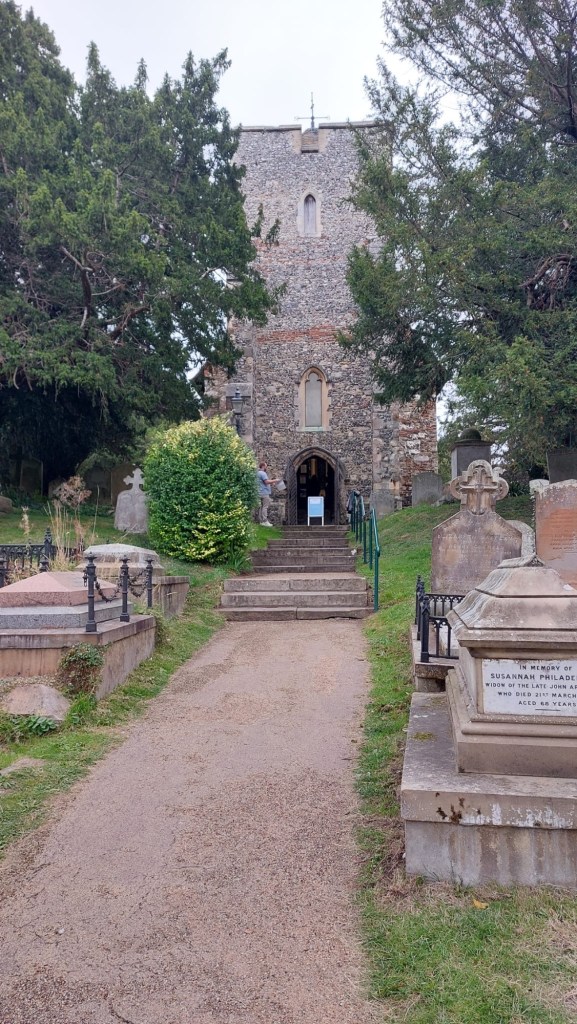
Pilgrimage Sermon at St. Martin’s Canterbury
Sept. 28, 2026
Hosea 2:14-23, Psalm 89:1-37, Acts 20:17-38, Luke 5:1-11
We stand here today in the oldest church in continuous use in the English-speaking world. This church has been a community of prayer and welcome in the name of Jesus Christ since before the year 597 CE. The oldest part having been built during the Roman occupation of Britain. Augustine, a Benedictine monk, arrived here in the year 597 with 40 companions, including Roman monks and Frankish interpreters, to preach the good news of Jesus Christ.
St Martin’s was already here when Augustine arrived in Kent. It had been renovated to be the private chapel of Queen Bertha of Kent, a Christian Frankish princess who married the pagan, Æthelberht of Kent, allowing her to continue to practise her religion. The church is thought to have been a Roman mortuary chapel before but Bertha dedicated it to Martin of Tours, a city located near where she grew up.
St Martin’s was Augustine’s first base for his mission. “Here, according to the Venerable Bede’s Ecclesiastical History, they first began to assemble, to sing the psalms, to pray, to celebrate mass, to preach and to baptize, until the king was converted to the faith and gave them greater freedom to preach and to build and restore churches everywhere.” (Bede’s Ecclesiastical History, AD 731).
Bede writes of the enormous impact made by the message of Jesus, by the holy lives of the monks, and by miracles which confirmed the message. “Great numbers gathered each day to hear the word of God…and enter the unity of Christ’s holy church as believers.” Pope Gregory, who sent Augustine from Rome, wrote to Augustine telling him not to become swollen-headed because of the extraordinary things that God had chosen to do through him. Ethelbert soon granted Augustine more land in Canterbury, where he founded the Abbey and the Cathedral and eventually became the first Archbishop.
I don’t intend to only tell you about history, yet to get us to pause for a moment and think about our links to our spiritual heritage here in this building. In the year 2026, we are 1900 years older than some of the bricks buried here in these walls. The people who made those bricks, laid the mortar to build a wall, and the prayers prayed here and eventually the sermons given were much, much closer to the time of St. Paul whose ministry we read about today. 100-200 years after the writing of the Acts of the Apostles, the first room was erected here during the Roman occupation of Britain with reused Roman building materials.
St. Augustine of Canterbury, not to be confused with St. Augustine of Hippo, is known as the Apostle to the English. Pope Gregory the Great sent him and his monks to re-establish Christianity on the isle, which suggests the faith had already been introduced. Queen Bertha most likely made his mission easier by setting an example of Christian prayer and worship before he arrived. Ever since then, Christian worship and prayer has continued here, uninterrupted, for almost 1500 years. Our prayers now join with the first prayers of Queen Bertha and the prayers and sermons of St. Augustine.
Paying attention to the lessons of our ancestors is an important practice that we forget in the modern age. While many cultures still honor their ancestors, we western modern folk often dismiss those who have gone before as “being out of touch” or irrelevant. Yet our spiritual heritage is equally tied to the thread that has been woven into the fabric of the church, and eventually became in our case, the Epsicopal Church in the United States. Should one think our ancestors were unwilling to change or that the church had to stay the same as it was when it was formed, I’ve got news for you. It never has.
When Augustine was sent to Canterbury, he asked the Pope why worship differed from Roman customs to the Gallic church. He assumed he was strictly bound to the Roman church customs. Yet the Pope told him not to do that but rather select whatever was pious, religious, and upright from the Roman church, the Gallican church, or any other source, and blend them together to form a custom for the new English Church. This advice created a flexible, adaptive approach to early English liturgy, laying the foundation for what would eventually evolve into distinct English liturgical traditions. And it is good advice for us today who fear any changes to the liturgy and practice.
While our faith remains rooted in scripture, reason, and tradition, the expression of our faith varies around the world in ways that are meaningful to the people and how they understand the Creator of the Universe and the Gospel of Jesus Christ. Our pilgrimage to the roots of our Episcopal faith opens our understanding of how the Spirit of God has held us together for centuries yet spoken to us in the languages we learned as children and in the environment and culture we know. It connects our outer physical travel with an inner transformation of faith. We hold the old and the new together.
The Book of Acts gives a glimpse of the pilgrimages of the followers of Jesus and the women and men who came together to support them and help deliver the New Covenant of God in Christ Jesus. Paul, our spiritual ancestor passed on this message to those who were to follow after him: “Keep watch over yourselves and all the flock of which the Holy Spirit has made you overseers. Be shepherds of the church of God.” We are linked with those who have shepherded the church for hundreds of years and are woven into this tapestry since Paul walked this earth.
Despite some of the things done over the centuries using the name of the church to condone the harm done to others around the world, God continues to redeem us and loves us unimaginably. In our Old Testament reading today, the Spirit of God prophetically claimed through the very weird life and marriage of Hosea, whose wife was a metaphor for unfaithful Judaists and subsequently, Christians, that “I will show my love to the one I called ‘Not my loved one. I will say to those called ‘Not my people,’ ‘You are my people’; and they will say, ‘You are my God.’” God is forever turning us around and walking us back to the Garden. That is the ultimate pilgrimage of our lives.
When Jesus was teaching along the shore of Lake of Gennesaret, the defeated fishermen who had worked all night long had no idea how this man was about to turn their lives, and the whole world, upside down. Yet the beckoning to follow was so strong that they put down their nets, left their boats and everything they knew and embarked on an eternal pilgrimage. This walk continues today with you and me as we persevere to keep The Way of Jesus Christ alive and moving, embracing everyone, even those the leaders of our day tell us we must exclude. The Spirit speaks to the people where they are, how they are, and who they are, “Come, and follow Jesus.”
It is said by many a spiritual leader that our purpose on earth is to love and praise God. Wrapped in our praises are the laments of the people, our anger about injustice, our fears and worries, and yet each prayerful song returns to the trust and praise of God. The first eighteen verses of Psalm 89 give testament to what wells up in our hearts and minds and souls when we keep our hearts and minds and souls on a journey with God, when we let the outer pilgrimage transform us and make us one with God. One should not isolate this song of praise from the previous Psalm 88 where the Psalmist laments, “I am overwhelmed with troubles.” And Psalm 90 follows with a song expressing the fear of God’s terrifying anger over their iniquities yet never lets go of the faith that God is with them, “Teach us to number our days, that we may gain a heart of wisdom. ”
We will return to the United States in a few days, but our pilgrimage continues as our faith is a lifelong pilgrimage. May we always remember we are connected to our ancestors from around the world who kept the faith in every country that we represent here now. Pilgrimage is about the continued transformation in our own selves and a reminder that we are the bearers of the faith for those who will come after us. The church may change and evolve from what we have known it to be as it has throughout our history, but we remain the Body of Christ of One God who unites us all. We sing the songs and pray the prayers of our ancestors and we continue so that they remain for all who will walk this journey with Christ until we are one day gathered back to the Garden of our Creator. Listen, you may hear the voices of the choirs and the prayers of the faithful echo from these walls as we sing and share in the Eucharist as others have here for hundreds of years.

