
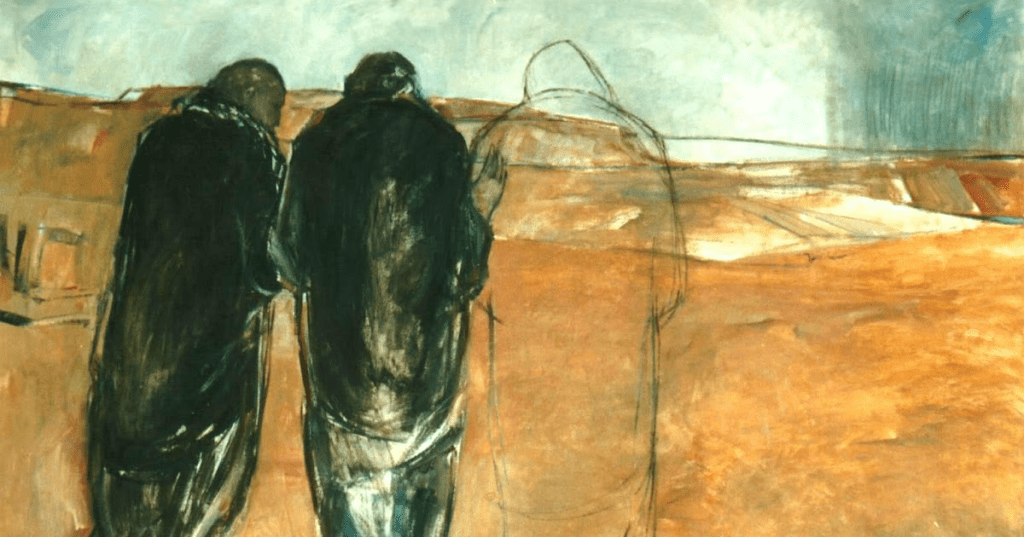
3rd Sunday in Easter, Year A
April 19, 2026
Luke 24:13-35
This year, as some of you may be aware, I have become immersed in the world of sourdough bread making. And by that I mean, I have joined a bread cult. There are Facebook groups and instagram sourdough queens and kings and just like that, bread has become its own universe.
Bread is an important element in the lives of people throughout the world and has always been. We know the French are very proud of their baguettes and brioche, the Italians their focaccia, and the Irish their soda bread. Then there’s chapati from India, arepas from Venezuela, barbari from Iran, taboon from Palestine, and pretzels from Germany. Our brothers and sisters from Turkey here in Austin invited us to break pide bread with them just last month. In our own congregation we might find tortillas, frybread, or Jamaican hard dough bread.
Breaking of bread is often considered a sacred action in inviting someone into a relationship, inviting them to become part of the community. It is the central action of our Eucharistic meal we share together each Sunday. I believe that is why our fellowship time after church is also an important weekly action of being together and telling our stories. It is fun, but it is one of the most sacred things we do in bonding our community together. Where else would you sit and talk, share your stories of grief and joy, offer to pray with each other, and learn from a group of people who you might not run into elsewhere? And what if I told you that when that break is broken, we just might encounter the risen Christ?
So let’s look at the beginning of this passage in Luke. For context, it is still the first day of the resurrection which started at dawn with a visit to Mary in the garden by the tomb. Jesus is busy because last week you heard that Jesus went to visit the disciples in the upper room that evening. But here in Luke, it’s probably midmorning of that first day.
Now a seven mile walk from Jerusalem to Emmaus takes a little over 2 hours, but if you’re engrossed in a deep discussion, that’ll probably slow you down considerably–and slow would probably be the only way I’d be able to make a seven mile walk.
We don’t know who Cleopas is, but we’re told that he and his companion–could be his wife or a friend, are disciples. Whoever they are, Jesus is intrigued by their discussion. I don’t know how acceptable it was in the 1st century in either Roman Empire street etiquette or Judean etiquette, to start walking with a couple of strangers and wiggle your way into their conversation, but that’s what he did.
These two on the road to Emmaus are troubled, though. They are trying to make sense of the death of some Jesus of Nazareth, “this prophet mighty in deed and word.” And here is the crux of their anguish and confusion– “We had hoped that he was the one to redeem Israel.” They confess a desire for a change of leadership that the Romans would certainly have found treasonous. Political conversations are risky even in contemporary times, but in the ancient world, such conversations could get you crucified.1 Allowing a stranger to step into this conversation was risky.
So, here’s Jesus eavesdropping and saying, “Hey, what are y’all talking about?” And Cleopas is aghast. Apparently, the death of Jesus was well-known news. “Are you the only stranger in Jerusalem who does not know the things that have taken place there in these days?” The Greek word for stranger here really means migrant, a resident foreigner. He’s clearly not from those parts, especially since he asks, “What things?” Yet what would they have missed out on if they had not welcomed the stranger into their discussion?
When Jesus asked these two what they were talking about, they just stood still, looking sad. What a poignant moment. They are stopped in their tracks because now they have to explain to this foreigner the trauma they’ve been through, the grief they’ve carried. I think some of you know how hard it is to truly express to another person, let alone a stranger, what your experience of grief is like.
They start telling this man who begins walking with them the whole story of what has taken place and you get to some of the saddest words in all of the Gospels, “We had hoped…” How heavy those words are, bound up in the hopes they once had that they now believe are just gone. Three years of ministry, gone in three days. They name their loss to Jesus. “We had hoped…”
This whole passage invites us to be on that road to Emmaus in our own contexts. How is it that resurrection comes to us? When is it that we encounter and recognize Jesus, because it doesn’t usually happen right away for us either. We often don’t recognize Jesus in the midst of us. Our faith and relationship with the risen Christ is a relationship of long walks, risky conversations, reframed traumas, and quiet dinners. An intimate relationship begins with Christ somewhere between words shared and bread broken.
Our faith isn’t automatic. It requires some reframing of the scriptures from how we first understood them, the retelling of the stories, meeting people, and entering into the places you weren’t expecting. Everything Cleopas and the other companion say to the stranger, reveals their disappointment, their fear, their grief, their trauma. The Romans picked the wrong guy and now he’s dead. The guy they thought was going to be powerful ended up getting his clock cleaned by the Roman Empire and it just seems like they are back to the same old place they were in before they ever even met Jesus. They are awash with sorrow and definitely confused, and the message to them was, you have no idea who you are with right now.
This scene starts off so tenderly, though. As they were walking to Emmaus and talking about these things that had happened, Jesus came near and went with them. Jesus enters our lives well before we know our faith, well before we recognize him, and he begins to open up the scriptures for us. That alone can be confusing, especially if you had preconceived ideas of what God was doing in the world. But Jesus meets you on the road you’re on. He doesn’t sit and wait for you at some intersection that you’re supposed to figure out how to get to on your own. He comes near, often as some stranger, and walks with you and joins the conversation.
One of the points of this passage is to explain that resurrection is not supposed to be resolved or understood right away. Just because you may not fully understand it now is not that you are deficient in your love for Christ, it is that is how the mystery unravels for us. It takes time. It’s revealed to us along the way, in conversation with others, not in an isolated incubation of your private thoughts. The revelation is a long walk.
Resurrection doesn’t solve things for us instantly. It doesn’t take away our experiences of death and loss. Your faith is not weaker because you doubt. Jesus gives the disciples this space to grieve, to not understand, and I think it is out of his observation of how deep the sorrow is for these two, for how much Jesus wants them to know things aren’t as they think they are, that Jesus exclaims, “You really don’t get it, do you?” So, he takes a deep breath and starts from the beginning, patiently linking all the scripture and the stories of the prophets together like a fine weaving.
Scripture evolves for us, too. The stories we learned when we were younger were simple and we took them at face value. Just think of hearing about Jonah and the whale in Sunday School and what you learned during our Lenten class from Steve Bishop about that story. Scripture has to brew in us, we have to wrestle with it, and we peel layers off throughout our lifetime and the core of the message becomes clearer.
Resurrection often shows up for us tenderly. Jesus’ first resurrection appearance to Mary in the garden was an intimate moment of calling her name while she wept. Later in the evening the disciples were locked in the room in fear of what may happen to them now, since Jesus was killed. Jesus appeared to them and in that vulnerable moment of meeting grief with hope, resurrection was announced to them with these words, “Peace be with you.” Then a tender invitation to Thomas to touch Jesus’ body, his wounds. And on the same day it is with Jesus joining the two on the road to have a warmhearted conversation, meeting them in their moment of grief and hopelessness.
Jesus started to walk on ahead of them when they reached Emmaus, but they were so engrossed with what was happening in their hearts that they pleaded, “No, no, please stay with us.” And so he is invited to their home and they recline at the table. A much more intimate way of eating than we do in our day, where they recline, often even leaning on each other, touching, and in this scene Jesus, the stranger, takes bread and breaks it–and that is when they recognize resurrection. That is when they know the stranger is Jesus.
While there is great rejoicing, fanfare, trumpets, singing and dancing when the resurrection is acknowledged and celebrated, it often first comes to us in small ways, in these intimate, tender moments when life has us disillusioned and disappointed. It comes to us in the intimacy of a meal shared with a stranger we have welcomed. It comes to us on a long walk when we just can’t make sense of it all. It comes to us in the breaking of bread.

