
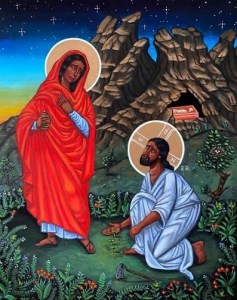
Easter Sunday 2026
John 20:1-18
In 2014 two rock climbing friends, Kevin Jorgesen and Tommy Caldwell, attempted the first ever free climb of the Dawn Wall of El Capitan in Yosemite National Park. Free climbing is climbing a rock face using no ropes, harnesses, or fixed anchors, but only the small finger and toe holds found naturally in the rock. While the route is broadly predetermined, the intricacies of the vertical passage must be puzzled out pitch by pitch, climber by climber. Forging ahead on his own, Caldwell navigated his way to the top on December 28, 2014. But Jorgensen remained on the mountain wall for ten more days — his nights spent on a narrow ledge, his days spent trying to rediscover the hidden path his partner had seen, or finding some other route up.
Imagine what it was like for him out there on that rock shelf, waiting every night for the sun to come up so that he could try again. Surely he would give up. Send for the helicopter; try again next year. Every day he stayed and tried again. And then one day, for no easily explicable reason, something inside him changed, maybe something in his sight adjusted, or his minute exploration of the rock finally bore fruit, and he saw how to climb to the top. I was moved by this story, the patience to wait while the path forward unfolded.
In our Gospel reading this morning, we find Mary Magdalene, alone and in the dark, encountering another rock–a rock which had blocked the way to a friend and teacher she loved dearly. The rock she found had been ominously moved yet she still couldn’t even look into the tomb. A rock that confounded her.
It was still dark, and probably darker in that tomb. I don’t know about you, but I’m not sure I’d look in a cave in the dark when I couldn’t see what was in there. We don’t know what she really saw or didn’t see, but that rock having been rolled away was to her in that moment a confirmation of what they all feared. The Roman government feared Jesus’ followers were going to steal the body and the followers and disciples feared the government would steal the body.
Mary runs to tell Peter and this mysterious disciple whom Jesus loved that they’ve taken the body, and the lads sprint to the tomb to see what has happened. All in confusion of the unknown. The man they called Messiah, Teacher, and Friend, their leader whom they had given up everything for–family, livelihood, friends–has been murdered by the state. The violence, the helplessness, the injustice of it all has them all wrapped deep in their own darkness of heart, mind, and soul. And now? They look in the tomb and what they believe is what Mary told them–his body has been stolen. Her fear becomes their fear.
They did not understand what Jesus had been telling them for months. They did not understand the scriptures. How could they? Would you and I have understood it in that moment? They still don’t know how to get beyond the rock–it remains an obstacle. Yet the door has been opened, liberation from the fear of what the shadow holds is at hand. It is no longer holding death, but freedom, and they can’t see it. So the guys go back home without saying a thing about what they saw, unlike Mary who stays.
That void in the tomb on this morning we have come to know as Easter, is where many of us frequently find ourselves. And in this scripture passage, we sit with Mary in the liminal space of dawn–the space that bridges light and shadows. The tomb indicates that full recognition and belief are yet to come. Mary Magdalene is the first witness at the tomb and she comes by herself to mourn.
Her grief has consumed her and she sits outside the tomb and weeps. Nothing makes sense. And as the sun begins to rise, she decides to face her fears and this time, look inside the tomb. We are all offered that choice. Cole Arthur Riley writes “If you wait to be unafraid, you’ll die waiting. Fearlessness is a myth. The terrors of this world do not sleep. Liberation is for those who tremble.” So, trembling, she enters a tomb. She gets past the rock.
In doing so two angels greet her, sitting where she expected an empty void. What she made of those beings sitting where Jesus’ body was supposed to be, we don’t know, she is focused on the one she lost. They did politely fold up all the linen cloths, though. And they ask her, “Why are you weeping?” Her answer is the same one she gave to the disciples. “I don’t know where Jesus is!” she exclaims. “I don’t know!”
Her answer is so human. It expresses what so many of us feel from time to time–where is God? And we honestly answer, “I don’t know!” She turns around and sees a person, and being in a garden it’s understandable that through the haze of tears, again she assumes in the veil of unknowing, that it’s the gardener.
She’s still weeping. Even angels didn’t take away her grief or confusion. Her sorrow is so deep. The supposed gardener also asks Mary why she is crying. And then he asks, “Whom are you looking for?” Interestingly, that is the first question Jesus asked his first disciples when he called them, and John is clearly making the point that Jesus sees her, too, as a beloved disciple. And the first to witness his resurrection.
Yet she’s just stuck on her own assumptions of what has happened. She’s stuck in the doom of the crucifixion. “Did you take him away?,” she asks the gardener. “Please tell me where he is so that I can have him back.” And now the sun breaks into the dark of pre-dawn, those first rays clear the horizon and light bursts into the scene, not with trumpets and fanfare, not with a crowd singing and praising, but simply in a loving, intimate, caring moment of Jesus speaking her name. “Mary.” Speaking one’s name is powerful, recognizing their dignity as God’s creation. She is not ‘those people’ or ‘that woman,’ but “Mary.” And as the dawn begins to break in a garden, it is quiet, still, and she knows who is before her.
The first witness of the Resurrection happens in a garden, at the break of dawn, to a woman who did not run and hide but stayed by the tomb. Mary’s confusion and doubt is not held against her. Her beloved Rabouni never reprimands her assumption and inability to let go of her worst fears. Jesus responds in love. It’s important to note that everyone responded differently to the misplaced rock, and they were all met with compassion and love, even if they just gave up for the moment and went home. The Resurrection still happened. Jesus still appeared to each one of the disciples.
In a garden there is life. In this Gospel, Jesus’ arrest, crucifixion, burial, and resurrection all take place in a garden. In the garden the incarnation of God and humanity hold together. Death is a reality of this earthly plane, but resurrection points to the reality of abundant life now and eternally. A seed dies and is planted, it remains in the darkness of the tomb but is actually being nurtured into life in the womb of the earth, bursting forth inexplicably to grow and bear fruit. The garden is a perpetual reminder that God is working to take us all back to the Garden of Eden.
And here’s the thing about this first day of the Resurrection, it’s only the dawning of God’s revelation in Christ Jesus. Our faith does not develop in an instant. It evolves, like it did with Mary. If she, who had walked the miles with Jesus in his earthly ministry and literally heard almost every word he spoke, did not understand what was going on in the moment, who was trapped in her own fears, could not even recognize Jesus when he stood right in front of her because her fear and grief blinded her, why would we expect any more from ourselves? Why would we think we had to have it all together and never doubt the promises that Jesus made? Why would we think God would abandon us or chastise us for not getting it at first? Every step towards resurrection does, however, will eventually get us there.
We will have a baptism today. And we will remember our own baptisms. When we lowered our heads over the font or were dipped in a pool of water, we were entering that tomb. Our faith begins in the dark. Angels may speak to us and we might not know it. The world today may seem so irredeemable and frightening that our fear and grief and anger may cloud our ability to see Christ at work amongst us and in us. Our baptism celebrates the Resurrection of Jesus Christ and lifts us up out of the tomb. Sheds light on the opening and path before us. Christ calls your name. Christ is here.
Today isn’t a final moment, it’s the beginning of understanding of hope and love and abundant life. It is and is yet to come–and like Mary, stay with it. Like Kevin Jorgesen, stay on the rocky cliff and don’t give up. You will find a way, with God’s help, past the rocky tomb and a way to climb up that you had not seen before. And the dawn from on high shall break upon you and you shall see glimpses of God. Come out of the tomb and see the Glory of God is all around you! You are Christ’s own forever! Alleluia, Christ is Risen!
 Magdalena's Musings