
5th Sunday of Lent, Year A
March 22, 2026
John 11:11-45
Thank you for listening to another novella from the Gospel of John this morning. It’s an important story but as I was beginning to prepare this sermon, I thought to myself, “Imagine being dead for four days, finally getting a mansion in heaven, experiencing no more pain or suffering—and then Jesus calls you back to the middle east with no air conditioning.” We never hear from Lazarus about how he felt about the situation.
Who we do hear from are his sisters, the women. In this story, instead of the women being introduced as to their connection to a main male character, Lazarus is introduced through them and Mary and Martha are given the dialogue. This is the last of seven “signs” that John gives in his Gospel, the first one being the miracle of wine at the Canaanite wedding. The purpose of these seven signs that are woven into this Gospel is to reveal the divine nature of Jesus and is punctuated by Jesus declaring I AM (the Bread of Life, the Light of the World, etc.). Beginning with his creative power in changing water into wine this final I AM statement is the climax–Jesus’ power over death. I AM resurrection and life, he declares.
Yet what I want us not to forget is even in this story of a sign, another revelation of the Christ, is that Jesus is still human, as well. And sometimes we have allowed these stories of resurrection to confuse us when we experience the loss of someone we love. Some of the worst things said to people in their grief deny the affirmation of that grief. Things like, “It’s ok, they are in a better place.” Ok, but I’m not! Or “Look on the bright side.” I don’t care how faithful you are, there is no bright side when you are grieving.
So let’s look more closely at what is going on with this scripture reading today. First of all, we need to set the stage. Jesus announces he’s going back to Judea and the disciples flip out. Why? Well, he made a lot of people really mad when he claimed that he and God, his Father, were one. But it was considered blasphemy. So, they tried to stone him and arrest him, and although he was able to escape, there was still a death threat on him.
It is clear that this little family in Bethany was very close to Jesus. They ministered to him as he ministered to others and he seems to have stayed with them frequently. So when the sisters sent a message to Jesus that Lazarus was very ill they probably expected him to come running. The disciples, however, were biting their nails–surely not! So when Jesus delayed 2 more days, there was some tension on all fronts. There was likely some inner turmoil in Jesus, too. Here’s a 1st century dilemma on (WWJD) What Would Jesus Do? Jesus himself may have not known what to do–do I go to my friends who need me and risk getting stoned to death or do I play it safe because there is more I need to accomplish? He’s torn–his friends want the former and his disciples want the latter. So when he announces he’s going back to Judea the disciples think he’s lost his ever livin’ mind.
And just to give Thomas due credit–since he has had to erroneously bear the title of Doubting Thomas for centuries–it is Thomas that shows true trust and commitment to following Jesus and rallies the others, “Let’s go, we follow him all the way, even to death.” Of course, that doesn’t happen, yet, but the commitment to following Jesus all the way is there. He wasn’t going to let Jesus face the danger alone. Furthermore, the idea of Jesus as the representative of God and of the disciples as representatives of Jesus is developed especially in this Fourth Gospel.1
Now the sisters pull no punches with Jesus. They, like most of us would be, are bewildered by Jesus’ delay. How often have you prayed only for Jesus to take his own sweet time to the point where it almost feels offensive? We, too, like Mary and Martha, have cried out, “Where were you when we needed you?” This whole story of Lazarus is so strongly in solidarity of our humanity and the struggles we have to understand God, the Christ in whom we have put our trust. Martha confronts him, Mary stays at home, possibly so deep in her grief she has no desire to go meet the late comer Jesus right away.
We already know from other Gospel stories that Martha will speak her mind to Jesus. And what is still surprising, is she still believes in him, still has faith, even if she is confused and angry. She stills knows and testifies that if Jesus had been there, Lazarus would not have died. You can see these two friends looking each other in the eye, trying to reason out the doubt and the hurt of misunderstanding. So Jesus speaks compassionately to Martha, “You know your brother will rise again, right?” Most Jews by the 1st century, save for the Sadducees and a few others, believed in life after death. So it might have seemed to Martha like one of those things well-meaning people try to console the grieving with one of those phrases that do not help at the time, like “Martha, He’s in a better place.” Forgetting that the pain and grief we feel when someone dies is that they aren’t here now. So Martha says, “I know that, Jesus. I haven’t forgotten there’s a resurrection on the last day, but it is not the last day and I miss my brother!”
And because Martha and Jesus are close friends and they are still looking at each other wrapped up in an intense conversation, Jesus goes deeper, hoping she will get what he’s trying to tell her. Jesus’ final I AM statement before he is arrested. “I AM the resurrection and the life.” Martha, it’s now. Life is now. Resurrection is now. Standing right in front of you. I AM resurrection. Learn to live in the now and the not yet. I am in you and you are in me and there is only life, even though your body may die. Do you believe this?
Can’t you just feel how she is trying to understand what he is talking about? We are probably trying to understand as well. We have not experienced God’s time, we really only have experience with chronological time, so Martha’s trying and while not understanding it all, is truly able to say to Jesus, “Yes, Lord I believe.” To believe is an action, not a commodity, and it co-exists with uncertainty, but is a trust that what Jesus is saying is true.
Jesus asks where Mary is and Martha sends her to meet up with Jesus who is still making his way down the road. And she has the same words for Jesus–”Where were you?” And is clearly so grief stricken she can’t even stand up. And all the friends and family, and the wailers, came with her.
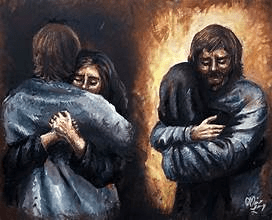
Folks had come from Jerusalem, so this family must have been well-known. The place where they lived was called Bethany which means House of the Poor, so it is quite possible that this family was known for caring for others, lifting up the afflicted. And when Jesus saw and felt how deep their grief was, it brought up his own grief, his own humanity. Mary and Martha were learning about eternal life in the here and now, and God, through Jesus’ incarnation in a body, is teaching Jesus what grief is like. Jesus weeps not only for Lazarus and the pain he is witnessing from others, but also for the death he is about the face. Witnessing and experiencing how people reacted to death was heart wrenching. Do not doubt that Jesus feels your pain.
“See how he loved him?” This comment from the crowd connects our pain and grief with what it means to love. When we love, our family, our friends, we also have to accept the struggle of love–joy and sorrow, life and death. Jesus accepts that to fully love is to fully feel–and this is what it means to love our neighbors, too. When anyone suffers, it is ours to suffer with–the true meaning of compassion. Jesus is one with Mary, Martha, and this entire crowd.
There are several resurrection stories in the Bible. This one foreshadows Jesus’ resurrection which was for all humankind. It is told to prepare us for what is to come and the Passion we will relive starting next Sunday. Lazarus will die again, but while he walks the earth, he now knows that he already lives in the resurrection. Living in Jesus IS life.
What’s the point of all this? Jesus says it in his final words in this story. “Undbind him and let him go.” To live the resurrection here and now is to liberate us from fear, from the fear of death, from the fear of all the things that bind us–addiction, anxiety, fear of each other, and fear itself. Jesus came that we might be unbound and be set free.
“Unbind him and let him go,” was a directive from Jesus to us. Jesus is the Resurrection, but he gave the work of unbinding to us. Remember how one of the key lessons from the Gospel of John is Jesus as the representative of God and the disciples as representatives of Jesus? We now are those representatives. Even though we will face a physical death, we are already resurrected. Life is now. To live in love, even with the grief that accompanies it, accepting our humanity and willingness to sit with others in the pain and sorrow, is to assist as Christ’s followers in the work of unbinding, to actively participate in liberating others from the tombs and the death they may be living in. Where are the tombs in our world today? We need to be there.
- SACRA PAGINA. Published by Liturgical Press
Accordance edition hypertexted and formatted by OakTree Software, Inc.
Version 1.1
↩︎
 Magdalena's Musings