
Epiphany Sunday, Year A
Jan. 4, 2026
Matt. 2:-1-12
Today we celebrate Epiphany Sunday, although the actual day of Epiphany is January 6th. My favorite of Shakespeare’s plays is The Twelfth Night and was a reference to the Feast celebrated as the eve of Epiphany, the final day of Christmas. Epiphany comes from a Greek word meaning “manifestation” and was the 2nd most important feast day of the church next to Easter. Before Christmas was set apart as a separate celebration on December 25th,the early church established the Feast of the Epiphany on January 6 to commemorate several miraculous events that “manifested” Jesus’ divinity: his virgin birth, the visitation of the Magi, his baptism, and the miracle at the Wedding of Cana1. Whew! That was a lot for one day!
Our Gospel reading this morning is rich with so many important images woven into this birth narrative of Jesus. Even as an infant, the God of the universe is blowing open the minds and hearts of God’s people to the unimaginable ways this Christ Child is going to change our concept of God, religion, and faith. There are two contrasts to God’s initiative of coming to earth in human form.
One, if we continued reading this 2nd Chapter of Matthew, we would find an episode of what we might call The Empire Strikes Back starring Herod as Darth Vader. As we will discover in a minute, evil reacted mightily to the threat of God incarnate.
That is the contrast to what we read today. God takes a new action in the conception of Jesus to manifest God’s saving presence in an imperial world dominated by sin. The purpose is to restore creation to its just order and relationship with its Creator. The division here is not between Jews and Gentiles, but rather a sociopolitical dynamic between the powerful settled center (Herod, known for his brutality, and the religious elite) and the apparently powerless, insignificant, and mobile margins (magi, Joseph and Mary.)2
Now to understand the power of this message in this scripture, we need to do a little debunking of the tradition around this Christmas and Epiphany story that has built up over time but has no bearing in scripture. Our tendency to try and make things look nicer or prettier than they really were was at play, some of it thanks to hymns we love like, “We Three Kings.” (Still a good hymn.)
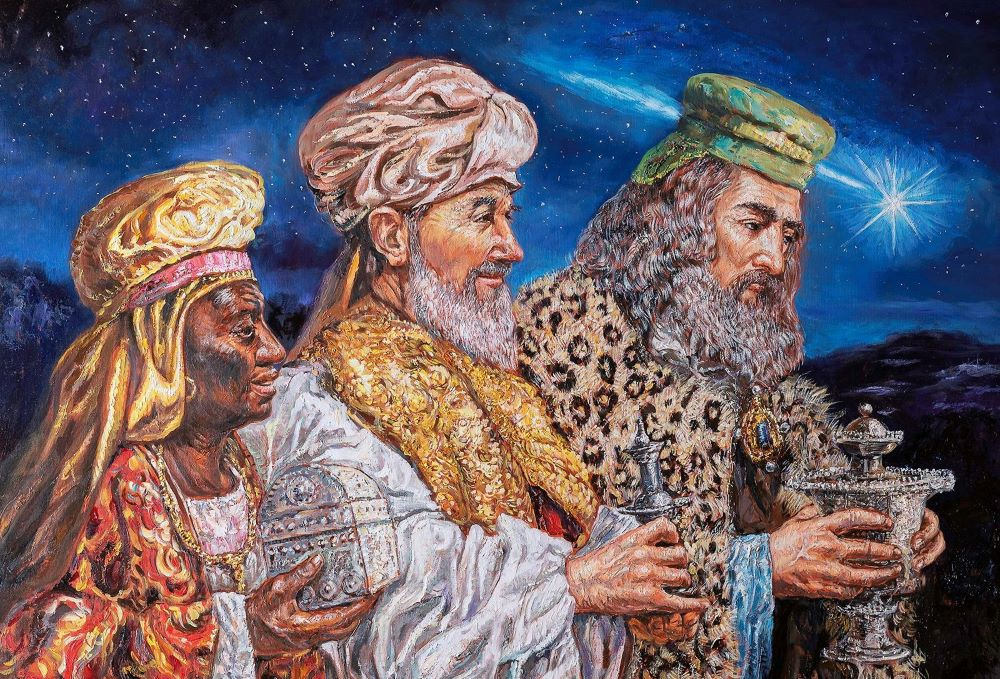
First off, Magi were not kings. Also, we don’t really know how many of them there were. There were three gifts mentioned, but not how many magi came. Magi, as in magician, were most likely Zoroastrian priests, at least some of them, from Persia and the surrounding area, what we know today as Iran.
They were ridiculed or mocked by some for their astrological predictions and “from the east” was often a reference to people who were negatively stereotyped by the west as slaves or freedmen, some calling them the equivalent of “low life.”3 But the magi also had access to power at some point as they were part of the priestly class that served the ruler in Persia. They could often be seen as threats to royal power as their influence could destabilize an empire with predictions of an emperor’s imminent death or the birth of a new king. Hence, they caught Herod’s attention when he got wind of them asking around Jerusalem about a new king that had been born to the Jews.
While the night sky is there to be noticed by anyone who looks up, the magi are diligently observant. They pay attention consistently enough, and with years of practice, to notice when something is different, when something changes. They observed what anyone could have observed, they were just the ones that noticed. Not only were they observant, they were motivated. Motivated enough to travel a long distance, astute enough to know that a new star signifies a new king in ancient belief, and discerning enough to know that the appropriate response was to offer worship. When they show up in Jerusalem, they state their motive–we have come to worship him. That was enough to set off a historically paranoid Herod. They did not offer that worship to Herod.
Herod is frightened. The Magi and the star are dangerous. In God’s scheme, Bethlehem is a place of new creation, Jerusalem is a place of fear. Bethlehem is a small, insignificant town with people living on the margins. Jerusalem is a center of power and a place for the elite. Matthew reminds us of the prophecy, “you, Bethlehem, are by no means least among the rulers of Judah.” Bethlehem is where Christ was born, amongst the people with whom the incarnate God would begin as a weak child. What the world sees as the least of these, God sees inexplicable possibility. God’s power, protection, and presence are encountered here not with the elite, not in centers of power, but with the marginalized, in the small places no one really sees. One has to pay attention to notice God at work.
When the Magi set out from Jerusalem with orders ringing in their ears from Herod, they saw the star again. These weary travelers let the Light guide them to the revelation of the Christ child. They did not give up. They went the wrong way a time or two, but they eventually got there. They did it by observing and listening. And like anyone who fully recognizes God’s guidance, protection, and presence, they break out praising God with exceeding joy when they finally find that baby. They are utterly elated and euphoric. They may not understand all that they are witnessing or what it all means, but they know it is a very big, cosmic event and they are amazed. They certainly make desirable disciples.
They notice Mary. That is no small statement that this child is noticed with its mother who is named, giving her great honor as well. The Theotokos, the God-bearer. They bow down and worship and offer gifts–gifts which throughout history, were given to a king. Gold, frankincense, and myrrh. Body, mind, and spirit are fully engaged in this sacred moment. The Magi are fully and completely engaged in the presence of God, kneeling, observing, listening with the inner heart. And these gifts were not just symbolic. They were practical, too. Mary and Joseph were going to need these items to fund their flight, seeking asylum in Egypt for the safety of their child.
What’s more important is that these were Gentiles, already present on the scene. We have one of the first of the worship services to the incarnate God with interfaith, international, interethnic–a sampling of the world at Jesus feet. Matthew is pointing out at the beginning of the story of Good News, that while Jesus was a Palestinian Jew, this Good News was for Judeans and Gentiles alike, for all nations, all people. He came for Persian magicians, he came for Jewish shepherds, he came for the poor and marginalized, he came for you, he came for me, he came for all his creation, and so began the work of bringing his creation back to wholeness, to walk us back home together.
This little baby was such a threat to the governing powers that the Magi understood that to alert Herod as to where this baby was to be found was to open the door for the Holy Family’s abduction and the death of the baby. So they again paid attention and listened to their dreams, and went home by another road. A different path than what brought them to Bethlehem took these early evangelists back to their land to tell their people the Good News what they had seen and heard. Signs of wonder, signs of light.
And we must mention that Jesus was, and I dare say remains, such a threat to the evil forces of power and greed. The verses we did not read this morning, verse 13-18, tell a story of Herod launching a campaign to round up all the toddler boys in the region. We remember this day on Dec. 28th as the slaughter of the innocents. Rachel was weeping for her children; she refused to be consoled, because they were no more. There aren’t a lot of hymns we sing about that, but we do solemnly remember and pray as these horrors continue today. It is a part of the story we must not edit out because there are consequences when one challenges evil. And there are consequences when one doesn’t.
Our story is also written in with these scriptures. God’s message to us, to the magi, to Mary and Joseph, to the shepherds, to the whole world. God’s voice of encouragement and compassion in a world that even Jesus warned us would have many troubles. It is summed up in four phrases repeated throughout the scriptures: I love you, I am with you, don’t be afraid, come home. In the darkest times, we are meant to hear this whisper all around us, I love you, I am with you, don’t be afraid, come home.
It is the Light that guided the shepherds and that guided the magi that leads us to find Christ. God shines the Light in these shadows and through our fears we encounter, and bends around it to help us take the next step. We are all walking home to God, and like the Magi, we often end up doing that by another road than the one we are on.
The Magi paid attention. The Light guided them to Christ and they knew the only response was to worship and offer the gifts they carried with them. The first to observe the Good News that God was at work with a plan so unfathomable to bring all children back home, back to the garden, back to the presence of God where one day all tears will be wiped away. All illness will be no more, all suffering will turn to joy. As the Magi declared, we too can enter into this space each week with the same determination, we have come to worship him.
- Dave Roos. “What is the Christian Holiday of Epiphany?” https://www.history.com/articles/epiphany-three-kings-day ↩︎
- William Carter. Matthew and the Margins: A Sociopolitical and Religious Reading. Pg. 73 ↩︎
- Ibid. ↩︎
 Magdalena's Musings