
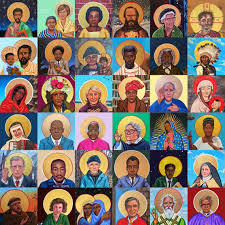
All Saints Sunday, Year C
Nov. 2, 2025
Ephesians 1:11-23
Luke 6:20-31
Today is an important day in the Church. On this day we are combining All Saints celebration, one of the seven principal feasts of the church year, which honors all saints, known and unknown; not just the famous ones but the ones who have walked ahead of us in faith whom we may or may not have heard about. Nov 2nd is known as All Souls Day, gathering the memories of those in the wider fellowship of the church, especially family members and friends, who have passed on before us.
And since All Saints’ Sunday is the principle Sunday for baptisms outside of the Easter Vigil, this year, we have a bonus celebration–the baptism of a new saint in the community, little Sawyer.
It is with Sawyer in mind that I read the letter to the Ephesians this week. What would we want Sawyer to know about Christ’s church? That he may know what is the hope to which God has called him? What are the riches of God’s glorious inheritance among the saints? That he is also one of the saints? What is the immeasurable greatness of God’s power?
And when I read the letter to the Ephesians again, I thought, what do we need to be reminded of in how we view our faith, we who have held this faith for years? What does it mean for us to be the Body of Christ?
I then reread the letter as if we had received the letter here at St. Christopher’s in Austin. Dear St. Christopher’s, “I have heard of your faith in the Lord Jesus and your love toward all the saints…” vs. 15. Wow, is that not what we would want those who have come to us to say about this church? I have heard of your faith and your love.
Grounded in faith and love, we can then honestly turn to each other and pray for this blessing coming from deep within our hearts: “[May] the God of our Lord Jesus Christ, the Father of glory…give [us] a spirit of wisdom and revelation as [we] come to know [God], so that, with the eyes of [our hearts] enlightened, [we] may know what is the hope to which [God] has called [us], what are the riches of [God’s] glorious inheritance among the saints, and what is the immeasurable greatness of [God’s] power for us who believe, according to the working of [this] great power.
God has called us to hope. And that hope spreads beyond our walls, becomes a light to all around us, and a light for Sawyer and all our children to know. A hope when all seems so hopeless to so many these days. There are riches of a glorious inheritance and God’s power is of immeasurable greatness.
“Paul’s, or whoever wrote this letter in Paul’s name, own decision not to submit to desperation is evident here; he does not wring his hands over the state of the world and equivocate, as we are apt to do. He declares in ringing tones that Jesus sits at God’s right hand in the heavenly realm and that he reigns over every other rule or authority or power or dominion or name. And God calls us to commit all that we are when we say “yes.”
The central point of Paul’s prayer is as old as the biblical story itself. That God, and Jesus as God’s Son, is above every power and therefore takes precedence over every other human attachment to any other power. Human resistance to that claim is also as old as the biblical story itself. Ultimate allegiance to God, yes—except when that allegiance interferes with what I perceive to be my own well-being. Ultimate allegiance to God, yes—except when that allegiance interferes with the sovereign right of the state.”1 What do we attach ourselves to?
Paul is pointing out that there is no lukewarm middle ground here. You’re either all in or you’re not. Ancient Israel struggled with allegiance to God and so did the emerging Christian church during Paul’s time. It is no surprise then that we do, too. We will go as far as we can with faith until we are uncomfortable and then go no further. Paul reminds us that God wants all of us, heart, mind, and soul.
This first part of the letter we read focuses on three things–concerning the church, concerning hope, and concerning power. Concerning the church, Paul is reminding the Ephesians that that the church is the vehicle of Christ’s glory to the world. Within and outside these walls. We are to shine bright and point to God’s glory–especially when times are dark and fearful.
It is true that one could wonder what in the world God was thinking entrusting the gift of salvation to such a beleaguered, befuddled, and often contentious lot. But there are times when compassion and grace just burst beyond these walls and point to something far beyond the sum of its members. As we celebrate all the saints today, it reminds us of the cosmic dimension of the church, that we are connected to the eternal unity of salvation that transcends time and space and our own understanding. The church is engaged with the ongoing work of salvation of all.
Concerning hope, the writer of the Ephesian letter prays for its hearers that their hearts may be enlightened, so that they may know the hope to which Christ calls them. When we see only with our eyes or hear only with our ears, we can easily forget this hope we are called to. When we see through the eyes of our hearts, we see beyond the facade in front of us and into a future, a kairos time of here and now and not yet of the true home God is preparing for us. As Christians we are shaped by more than our own experiences; we are shaped by our hopes, remembering the promise of a kingdom which we are co-creating with God. I am reminded of one of my favorite poems about Hope by Emily Dickinson,
“Hope” is the thing with feathers –
That perches in the soul –
And sings the tune without the words –
And never stops – at all.
Hope is best lived within the hopeful community, in the company of saints both living and departed. “An old tale tells of a disciple who asked his rabbi the meaning of community one evening, when they were all sitting around a fire. The rabbi sat in silence while the fire died down to a pile of glowing coals. Then he got up and took one coal out from the pile and set it apart on the stone hearth. Its fire and warmth soon died out.2
It is in the community of saints that we find our life and vitality as we seek to live as faithful bearers of the inheritance we have received. In such company we find comfort in our losses, courage for the daily struggles, and hope as we face the future together.” We hold on to our hope when we hold on together.
Now the last verses here are concerning power. Not the kind of power we see wielded against others, used to make one richer, or in control, or even in an attempt to make one a God. Which, of course, was exactly what the Romans were doing at the time–Ceasar was God and the citizens and occupied were expected to worship him as God. But Christ’s power is “far above all rule and authority and power and dominion,” for there is a battle at hand. We may tend to overplay or underplay the dimensions of the struggle, but there is no avoiding the struggle itself. I think we have become well aware of it these days.
The world is ruled by powers hostile to the redemptive power of love and forgiveness, and thus hostile to Christ and to Christ’s community of saints, the church. Before the foundations of the world, the writer reminds the Ephesians, God chose, and continues to choose, the oddest and unlikeliest of saints to be agents of divine power in the struggle. You may feel small and powerless yourself, but we are a community which is linked to God’s immeasurable greatness. C.S. Lewis once said, ““How monotonously alike all the great tyrants and conquerors have been. How gloriously different are the saints!”
We may protest that we are not up to the task, that we lack the courage and the strength necessary to live faithfully in such tumultuous times. To such protests the Ephesian letter serves as a reminder of whose power is at work in the life and witness of the church. Theologian Stanley Hauerwas argues that Christians cannot try to become saints. Nor, he says, are saints heroes and heroines of faith. Instead, they are “people like us who have been made more than we are by being engrafted into God’s kingdom that is ruled by forgiveness and love.”
So, I saw to Sawyer and to all the saints seated here today, remember your faith and your love towards each other. May we pray for a spirit of wisdom and revelation as we come to know Christ more intimately, so that, with the eyes of our hearts enlightened, we may know what is the hope to which he has called us, what are the riches of God’s glorious inheritance among the saints.
- Mary H. Schertz. Feasting on the Word Year C. ↩︎
 Magdalena's Musings