
18th Sunday after Pentecost
Proper 23, Year C
Luke 17:11-19
Oct. 12, 2025
We have spent much of this year in the Gospel of Luke. Following Jesus and his disciples, we’ve picked up on some recurrent themes that were important to Luke and the community to which he was writing. We are modern day disciples of Christ, still being taught and witnessing Jesus, God in human form, demonstrating God’s love to the world as we hear how Jesus interacts with those in the 1st century, most importantly with real, actual persons. And unlike most hero narratives, Jesus is a different kind of leader.
Remember that Jesus is still on his way to Jerusalem. “On his way to Jerusalem” in Luke means he is on his way to his death. He is aware that he will face the powers of the empire that seek to oppress and destroy the marginalized and disenfranchised, getting rid of anything and anyone that threatens their power and control. But Jesus does not spend his time wringing his hands, nor allowing the fear which people were living under paralyze him. Jesus has a freedom the forces of evil and sickness cannot take away. This is the world in which Jesus walked the earth, living under the occupation of the Roman Empire which promised peace only to the wealthy and privileged and those who would worship Caesar, but he was always pointing to the presence of God, the Kingdom of God, and how to recognize this presence–even in a difficult and often frightening time. Never is Jesus focused on fear. Jesus knew there was a greater power at work in the world and he was intent on teaching his followers how to trust it and how to see it and how to act on it. The power of God that is at work in a broken world which is greater than what any of the disciples could see or comprehend. Jesus demonstrates this over and over again because I believe he knew how hard it would be for his followers to have faith and to hang on to it.
Today’s passage gives us a peek into what living fully into our faith looks like. As Jesus continues on the way to Jerusalem, he is found walking in the margins between Samaria and Galilee. That is a detail to notice. Because what they encounter in the inbetween space is a group of 10 men who live on the margins of society and who are suffering from skin diseases–probably not Hanson’s disease as we know leprosy today–but an unsightly and painful skin disease nonetheless. They keep their distance, but they must have heard of Jesus’ healing ministry and collectively decided to seek him out and they call out to him. It’s interesting that they don’t say, “Heal us,” but rather “have mercy.” It is a prayer.
Jesus doesn’t stretch out his hand and heal them. He just simply says, “Go and show yourselves to the priests.” For the Jewish men that would be the Temple in Jerusalem, and for the Samaritan, Mount Gerizim. What is amazing is that the stories about Jesus being a healer must have been profound enough for them to trust what he said, and although it did not make any sense at the time–because why would you head off to the priests who can proclaim that you are officially healed and allowed to re-enter normal society when you aren’t healed yet? But they do it. All 10 of them have enough faith to do exactly as Jesus told them. They go and are physically healed along the way.
Now all 10 of these guys in our Gospel showed a willingness to trust Jesus and carry out his instructions without question. What this cleansing of the lepers would have meant was not just being healed but the possibility of being incorporated again into normal Palestinian society. We all know how important community and fellowship is, and being received back into the Temple and returned to society meant just as much as being physically healed. They were restored in body, but also to family and friends.
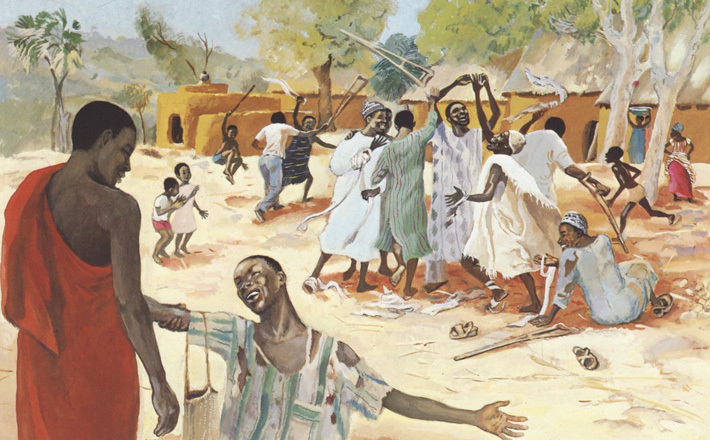
But one of them, when he saw that he was healed, turned back praising God with a loud voice. The emphasis on the first part of this sentence is on “seeing.” This wasn’t just a glance or a noticing–seeing is deeper. The eyes of his faith were opened. In the Lucan story this is an awakening. He saw more than just his clean skin.
It is at this point the awakening in this one man causes him to depart from the instructions and instead turn back to praise God and fall on his face in front of Jesus. An act that demonstrated his deep gratitude. This seeing was a recognition that Jesus was the priest he presented himself to, Jesus was not just any priest but the one who restored this man to health, to a community, and most importantly ignited a transformation of his whole being–body, mind, and soul. The man paid homage that was due to a king, a recognition of Jesus as an agent of God. And Luke kinda slips in here–and, oh, by the way he was a Samaritan.
This little comment is intentional. Luke really emphasizes Jesus’ ministry to those who were typically the outsiders of society–both religious and civil. Once again it is the foreigner, the one who was a religious outcast, in fact despised by the Jewish people, that returned to give thanks to a Jewish man in whom he recognized the presence of God. In our context today this man would be one not usually welcome in a church, one who is not welcome in our community, one who would make most of us uncomfortable to be around, one who is rejected. You are familiar with the list. It is this one that receives not only physical restoration but a salvation–he is made whole.
“Where are the other nine?” Jesus asks. Jesus looks at this Samaritan man–”your faith has made you well.” He does not take away the healing of the other nine, but they have missed the opportunity to be made whole.
The difference between healing and wholeness was recognition of God, giving voice to gratitude in the form of loud praise. This is Eucharist–a great thanksgiving. In between receiving and giving thanks was the ability to pay attention and see. Gratitude caused an awakening in this man that transcended ethnic and racial barriers, that transcended religious barriers, that transcended cultural norms, and any slur or antagonism put in his way previously–Jesus was the one to turn to and worship and give thanks.
Jesus healed without discrimination. They all had faith. But the one who put that faith into action, and turned around to give thanks, found a salvation of wholeness. Jesus healed but faith in action transformed the Samaritan. More than just saying “thank you,” this is an outpouring of worship that shows us the Samaritan is the only one that gets the full benefit of Jesus’ healing. He demonstrates a faith that lays hold on God, that cannot and will not remain silent in response to what God has done in his life, that publicly, spontaneously, and joyfully directs his thanksgiving to God. Go, Jesus said. Your faith has made you whole. They were all healed. One was made well.
Faith is to be lived out in thankfulness, in gratitude. “When Jesus says that the man’s faith saved him, we see very clearly that Luke is not suggesting ‘your belief in a set of propositional truths that gave you keys to heaven.’ What Jesus seems to be saying is more along the lines: ‘your trust in my word and power motivated action from you that transformed your life in a way that you have experienced the salvation of God.’ Basically, faith leads to action!”
Eucharist means to give thanks. We give thanks as we receive the presence of Christ and our faith becomes a life of thanksgiving. This Samaritan leper gave thanks for being cured of dis-ease. Thanks for Christ being present in the midst of dis-ease regardless of the fear and injustice around him. The Samaritan would now walk in a world that still despised him but it was Jesus that made him whole, not anything the world could offer.
Meister Eckhart, a 14th century priest and mystic, wrote, “If the only prayer you ever say in your entire life is “Thank you”‘ it will be enough.” Our worship is our outward sign of our thankfulness, returning again and again to receive the presence of Christ, taking and ingesting that presence at the altar. “Worship is certainly at the heart of the Christian life, and the story of the one who returns to give thanks points us to that truth. God promises to be at work in the world, in our church, in our lives; so we cannot but give thanks.” Faith is complete when it includes thankfulness.
Today when we say together the Eucharistic Prayer, “Let us give thanks to the Lord our God. It is right to give God thanks and praise,” may we do more than just notice or acknowledge the words, but hear them deeply, see the Christ who makes us whole, and may our hearts and minds respond in true worship “It is right, and a good and joyful thing, always and everywhere to give thanks to you, Father Almighty, Creator of heaven and earth.” The basic Christian response to God is gratitude regardless of the worldly circumstances in which we find ourselves. This Great Thanksgiving calls us to lead eucharistic lives. Lives of thankfulness.
In a few minutes we will stand and sing, “Praise God from whom all blessings flow.” May thanks and praise transform you and make you whole.
 Magdalena's Musings