
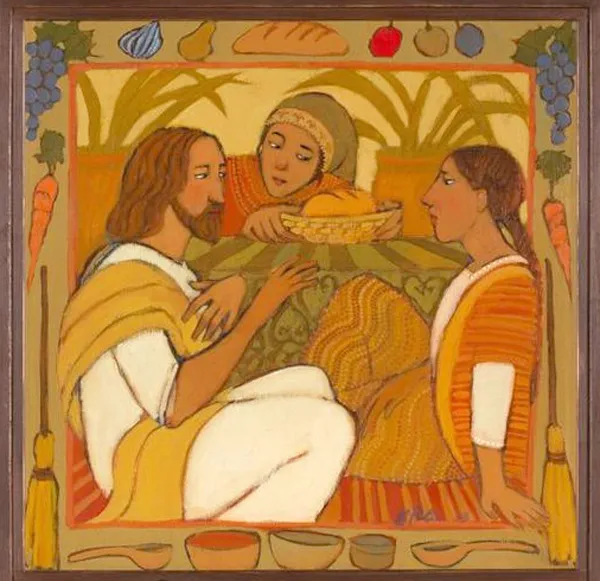
6th Sunday After Pentecost, Proper 11
Jul 20, 2025
Colossians 1:15-28
Luke 10:38-42
This may date me, I can’t help but read today’s Gospel without hearing Martha, Martha, Martha. And, how do we solve a problem like Maria?
I just want to say, as an oldest daughter, I get Martha. And to be fair, Jesus was just talking about the importance of hospitality last week! I think anyone who has a sibling understands this story in the context of how families work. I mean, most of us have had instances when we have chosen to do something and then wanted to be appreciated for all the work we’ve done. But Luke doesn’t include this little interaction with Jesus and the two sisters to embarrass Martha and Mary.
Just last Sunday Jesus asked an expert in the law, what does the law require? To love the Lord your God with all your heart, and with all your soul, and with all your strength, and with all your mind; and your neighbor as yourself. And then Jesus went on to explain what loving your neighbor means and what it requires of us in the story of the Good Samaritan. Following that parable is the interaction between Martha, Jesus, and Mary. Last week was about loving your neighbor, this week is about loving God with all your heart, soul, and mind.
If you’ll remember, Jesus was traveling with at least 70 other disciples and it was Martha who greeted them and invited them into her home. She was fulfilling the duties of hospitality and it was probably a lot of work to get a meal prepared and other arrangements for her guests. Those efforts were good and they were undertaken with good intentions. But the key to what caused the problem wasn’t Mary. The key is in verse 40: But Martha was distracted by her many tasks.
Martha and Mary, and their brother Lazarus, were dear friends of Jesus. Was this the first time Martha welcomed Jesus into her home? We’re not sure of the order of his visitations but we do know that Jesus visited often and stayed with this family many times. It’s clear Martha has a close enough relationship with him that she feels comfortable speaking her mind. Not only in this visit but also when her brother died and Jesus failed to show up in time.
Martha and Mary are not mere tropes or proxies for any other agenda, ancient or modern, but [they are both] images of faithful discipleship.1 It’s important to remember that Martha is fulfilling her obligations as a host and a woman in the 1st century in the ancient Middle East. Martha is also acting like a deacon and she is performing her ministry to care for the weary and hungry travelers. Hospitality was commended by Jesus. He is not condemning what Martha has chosen to do.
Mary, on the other hand, is doing what only a man was allowed to do, sit at the feet of a Rabbi to learn. That would have been distracting not only to Martha, but even more so to those gathered in the home. A woman sitting at the feet of a teacher would have been as scandalous as a Samaritan being the one who fulfilled the requirement of the law to love one’s neighbor. Granted, Mary is not asking any questions and sits quietly, but she is drinking it all in. So, Martha interrupts what’s going on to see if Jesus is going to do anything about it. Plus, the woman needs some help! Are Jesus and the disciples going to help put the meal together if Mary isn’t going to?
What too often has happened when taking this story of the two sisters out of the context of the whole Chapter in Luke is that we tend to think that it’s about listening to Jesus versus hospitality. But it’s not that. Both are important. This is about letting distractions and busyness take priority over spending time with the Lord, which is the better part.
I think most of us here would agree that we let distractions and tasks and the tyranny of the urgent dominate our lives. What Jesus affirms here is that Mary chose the good part. Stopping, taking in what was nourishing her mind and heart so that she could serve from a place of love. She was feeding on the living word which was what was most important in that moment. The Kingdom of God had drawn near to her. The disciples were going to get fed. Right at that particular moment, Jesus was feeding them and Mary was paying attention.
Martin Luther allegedly was quoted as saying, “The more I have to do, the more I pray.” Imagine if we were to practice this. Leo Babauta, author of “The Power of Less,” states in his research that “Having a lot to do isn’t the same as actually getting a lot done. Most of the time, people who have a lot to do end up doing a lot of unimportant, unnecessary things.” Many disciples throughout history chose to live in communities devoted to work, study, and prayer, like the Benedictines. They got a lot done and paid equal attention to prayer and study. Franciscans were out in the world with the poor, feeding, tending wounds, and preaching the love of Jesus, but spent even more time in prayer.
We, as Christians, are required to tend to those in need and address injustice. Scripture is clear that we don’t get to dodge that, as we learned last week. But, we are to never undertake those tasks without prayer, scripture, and Sabbath rest. Rest and prayer, sitting at the feet of our God, is holy work and Jesus, knowing our human need to look successful by being busy, tells not just Martha, but the rest of us that our holy work is in service, but first to be still and listen. Pay attention to the work of the Holy Spirit in you and when the Kingdom of God draws near, stop and be present.
Something in Mary recognized the holy and sacred that had entered her home and she broke with custom and protocol, making herself open to criticism that she needed to remember her place and go back to the kitchen. But the draw of Jesus was stronger, and the repercussions of her actions to listen and learn from the Son of God were immaterial. What she noticed in paying attention to the teacher that had been welcomed in was something Paul points to in his letter to the Colossians which we also read today. Jesus was more than just a profound teacher.
In the first five verses of the passage in Colossians, we listened to Cathy read us one of the oldest hymns about the divinity of Jesus that we have. These five verses were a hymn written by the earliest Christians before the Gospels, written before Paul’s letters. I’ll remind you of the words of praise sung by the first Christians starting in verse 15.
“ 15 [Christ] is the image of the invisible God, the firstborn of all creation, 16 for in him all things in heaven and on earth were created, things visible and invisible, whether thrones or dominions or rulers or powers—all things have been created through him and for him. 17 He himself is before all things, and in him all things hold together. 18 He is the head of the body, the church; he is the beginning, the firstborn from the dead, so that he might come to have first place in everything. 19 For in him all the fullness of God was pleased to dwell, 20 and through him God was pleased to reconcile to himself all things, whether on earth or in heaven, by making peace through the blood of his cross.”
Sitting at the feet of Jesus is sitting at the feet of God. Not some god who will entertain us, not some god we make in our own image, not the buddy Jesus, but the fullness of the God of the universe, who was present at the creation of all things, the beginning and the end, the Christ who God was pleased to dwell in all fullness. This is the claim of the first Christians–Jesus is God. He is the head of the church. How can we even begin to fathom the full breathtaking, astounding magnitude of this God if we do not pause to sit in Christ’s presence and listen? How can we truly worship a God we don’t take time to acknowledge the presence of? The only sustainable way for Christians to feed the poor, care for the immigrant, welcome the stranger, offer love and a community to those the world is rejecting, respond to tragic disasters, and avoid the tendency to just take care of ourselves, is to sit at Jesus’ feet and be replenished. To be still and know that he is God.
Martha was serving and doing her ministry of hospitality, but she became overwhelmed with the distractions of the tasks and the number of people that needed food and shelter. We are worried and distracted by many things. For the suffering need us and we are going to have a lot of challenges in the days ahead to meet that need. We can only do so if our hearts and minds are fed and rested. Come, sit at the feet of Jesus and be fed at this table today. Let Christ, the fullness of God, fill you, restore you, make his face to shine upon you, and call you his Beloved.
- Andrew McGowan. ↩︎
 Magdalena's Musings