
5th Sunday after Pentecost
Jul 13, 2025
Luke 10: 25-37
We all love a good story, don’t we? And today’s Gospel contains a story most of us have heard many times. So popular that even non-Christians have heard of it. Google Good Samaritan and you might find a reference to the Bible verse, but also hospitals, roadside assistance, senior housing, and even law firms bear the name ‘Good Samaritan.’ It is all meant to portray an image of goodness, of kindness, of a response to those in need.
But because we have heard this story so many times, we no longer get the startling impact of what Jesus said and what his listeners would have heard. So we have to really take a close look at this interchange between the lawyer who is confronting Jesus and the answer Jesus gives to the questions, “What must I do to inherit eternal life?” and “Who is my neighbor?” Because the answer lies in how these two provocative questions are linked together.
In the first question, the lawyer seems to approach his desire for eternal life as if it were a commodity, something he can check off a list as a one time test so he can walk away with a merit badge. Ok, got that done, I’m good. Sort of like the approach to salvation that it is just a one time acquisition if one says the right words and gets right with God. I’m saved, so I’m good. I’ve got my eternal life.
Now, Jesus knows he’s being tricked. It’s not an innocent question. The expert of the law asking him about eternal life–a matter written into the heart of the Torah and every Judaist. So, when Jesus asks him,”What is written in the law? What do you read there?”I can almost hear my mother’s voice in Jesus’ reply, “Ok, smarty britches, you’re the legal expert. What does the law say?”
He answered, “You shall love the Lord your God with all your heart, and with all your soul, and with all your strength, and with all your mind; and your neighbor as yourself,” putting together Deuteronomy 6:5 and Leviticus 19:18. Right answer! replies Jesus. Go do this and you will live. Meaning eternal living starts now. Remember from last week, the message of the disciples–the Kingdom of Heaven has come near to you. Love God and love your neighbor now. It’s a way of life, not an acquisition.
Jesus and the lawyer both agree on what the law says. But the lawyer can’t let it alone because, like most of us, when we want to find a loophole to get us out of really doing the thing, we’ll try to find a way to justify our current behavior. The lawyer asks, “Who is my neighbor?” It’s a nice way of asking, “Tell me who I don’t have to love.” So, to answer that question, Jesus says, “Let me tell you a story. Once upon a time…”
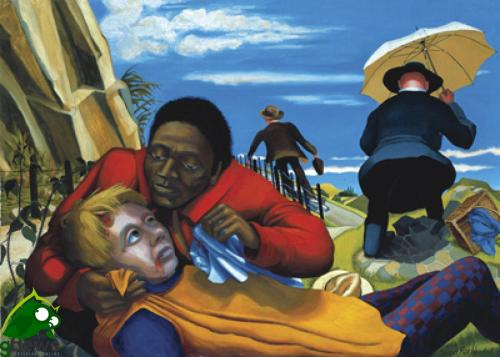
There are a lot of characters in this story. The man in the ditch is probably a Jew, as suggested by the wider narrative, but he’s not identified leaving speculation that he could be anybody. Any person in need. Jesus does not explain why the priest and Levite—highly esteemed Jewish religious figures coming down from Jerusalem, most likely the temple—neglect to assist one of their own people. The parable treats their staying across the road from a fellow Jew in need as a shocking event. Many have excused them as having to adhere to purity laws regarding touching the dead, but nothing indicates that they think the victim is dead or that they fear contamination; even if the man were dead, such purity concerns would be insignificant compared to the weightier need to arrange for a burial, a requirement of their office. The point is that two people who presumably represent the identity of the victim do not express any concern toward him and remain unwilling to assume the risks that come with pausing in a dangerous place. It’s too complicated to get involved, is a common human response.
The Samaritan’s introduction into the story is a jolt to those listening. We are so used to hearing “Good Samaritan” that we can’t truly comprehend how offensive this would have been. To most Jews in Jesus’ world, this character represents an enemy, the other. This is like inserting any so-called “enemy” many think we have. Imagine Jesus telling us here today, and along came a trans person, or an undocumented immigrant, or (insert someone from another political party). People probably gasped when Jesus mentioned a Samaritan.
In direct contrast to the unconcern of the priest and the Levite, the Samaritan, the outsider, shows compassion. The Samaritan treats the man not as an enemy but as a brother. He doesn’t just call 911 and leave the scene, but changes his travel plans and with a tenderness, he cleans the cuts and bruises, tends to the wounds, and then takes him to a shelter where he continues to care for him until it’s ok to leave him in the care of another. It’s worth noting the innkeeper is helpful, too, although paid to be. The Samaritan doesn’t just make it better, he is determined to see the man healed and well again and stays committed to that goal. His exemplary deeds, born from compassion, demonstrate the lengths to which love goes. Authentic love does not discriminate; it creates neighborly relationships, because by its nature it meets the needs of others. We have heard stories of mercy and compassion coming out of the tragedy of the flooding in the Hill Country, when people suspended their judgments and animosities to literally tend to the wounds of folks in the ditch. When borders disappeared and rescue workers from Mexico rolled up their sleeves alongside the Americans. These are glimpses of the goodness inherent in us. A natural instinct to respond with mercy and compassion transcends any propaganda they’ve been told about the other.
In a discussion hosted by the New Statesman, former Archbishop Rowan Williams once spoke to philosopher and British atheist, John Gray, who acknowledged that the ancient Christian faith was the origin of the modern western value of not being cruel or tolerating cruelty towards others. Gray commented, “The distinctive contribution of Christianity is that, if you think back to the ancient Roman world, then one feature that came in with Christianity was the idea that human beings, reflecting the nature of a Christian God, had some responsibility to not being cruel, not even tolerating cruelty.”
Flavius Josephus, a first century historian, wrote about Jesus and his followers and how some Christians were known for their love and care for others. What would it be if history remembered us in this way, two thousand years later?
We are to see ourselves reflected in Jesus’ parables. These are lessons in bringing in the Kingdom of God. Naturally, we rarely want to admit we are the ones that walked by the man lying in a ditch. But we do. Some of us may be so beaten up by life at times we feel as if we are the one in the ditch, bruised and battered. But we really hope we’re the good guy, in this case, the Samaritan. And I think that’s the message Jesus is getting at, but there is something we need to recognize in that. The Samaritan is the outsider. He is the enemy of the others in this story. He is the hated one to those listening to Jesus tell this parable, who are incredulous that Jesus would suggest the Samaritan is the one who actually acted as the loving neighbor. When we do love our neighbor in this way, it does not make us popular. “Who is the neighbor to the man who fell into the hands of the robber?” Jesus asked the lawyer. And the lawyer truthfully replied, “The one who showed mercy.” Jesus ends the conversation by saying, “Go and do likewise.”
My friends, we can’t be afraid to show mercy to any neighbor. There is no caveat, there is no loophole like the lawyer was trying to find to get an exemption from helping those he did not want to help. Upholding the dignity of every human being is a vow you and I have made to God and repeat over again at every baptism as a reminder. In the words of C.S. Lewis, “There are no ordinary people. You have never talked to a mere mortal…Next to the Blessed Sacrament itself, your neighbor is the holiest object presented to your senses.” May we honor that holiness, that sacredness, and the dignity in each other and in those who need us to take the risk, tend and bind up wounds, and care for the hurting until they are well again. That, my friends, is how we all find eternal life. Who loves God and neighbor? The one who showed mercy. Jesus tells us to go and do likewise.

 Magdalena's Musings