
3rd Sunday After Pentecost, Proper 8
Jun 29, 2025
Galatians 5:1, 13-25
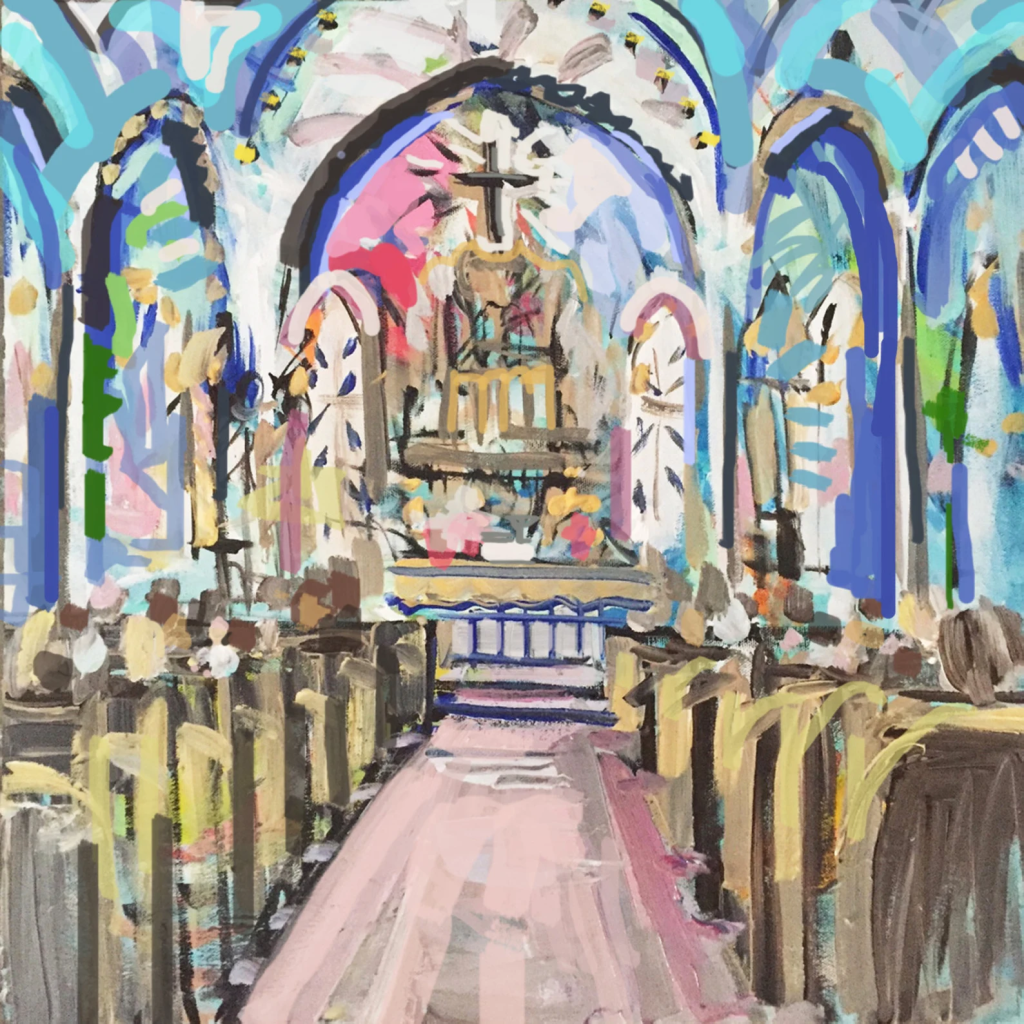
Well, Happy Birthday, St. Christopher’s! On July 4,1976 St. Christopher’s held its first service led by Fr. Riker. And here we are today, 49 years later, continuing in celebrating God’s love, sharing in the Eucharist, and offering our prayers, a people still faithful, still praying, still a light on a hill. And we celebrate this anniversary of our church on Independence Day. It’s quite remarkable, therefore, that today we read the letter to the Galatians from Paul who talks about independence and freedom in the context of what Christian freedom means.
Galatians is probably Paul’s most consequential letter to the Church in its early days. And the early days of the church were dealing with the same struggles the church has dealt with throughout history and even today. Because try as we might, when human beings are part of the equation, we do not always get it right. We try to form God in our own image, we give precedence to other gods, we try to use Scripture to our own advantage, and we fail each other. Our tendency to control the narrative of the Good News often leads to fracture in relationships and in ministry. Yet our faith, our church, our ministry is first and foremost about relationship, and because God delights in us, we continue to be a work of love and never abandoned.
The weird thing about our God is that God is not some old man in the sky trying to slap us around or punish us if we break a rule, controlling us like puppets, our God desires us, desires a relationship of intimacy. “I in them and you in me—so that they may be brought to complete unity,” Jesus prays in the Gospel of John. Because of this desire, God came in the form of Jesus, a man who walked on the earth, to eat and drink, pray and teach, suffer and celebrate with us. And that continues through Christ’s Spirit who resides with and in us now. If we listen. If we pay attention, we come to know this.
So as we celebrate the birthday of St. Christopher’s, our readings remind us of the New Covenant with Christ that we have vowed to live out, with God’s help, and work out together what it means to be Church. We are called back to be centered in Christ, grounded in Scripture, listening to the Spirit, and today we reflect on where we stand now. How we are to be in community with one another, how do we listen to the guidance of the Spirit, and what is God asking of us today?
The letter to the Galatians was written to a cluster of separate Christian churches throughout the province. And guess what–I know this might surprise you–they were squabbling. Paul’s letter leads us to believe it was pretty intense. Disagreeing vehemently over the law and who was the most right in following it. Paul shreds that apart for everyone there and redirects them back to a different foundation of understanding, to the foundation that is Christ, the foundation the Church was to be built on which was freedom from imposed slavery to the law. More on that next week.
Chapter 5 is a shift in the emphasis of the letter to the real conflict in Galatia. Paul gets really candid here and addresses the issues of ethical norms and community rules that specifically target divisive behavior like “biting and devouring one another!” in verse 15. Or “competing against one another, envying one another” in verse 26.
In between those two statements, which sound a lot like, “Knock it off!”, Paul lists a catalog of vices and virtues. Although it’s in a pattern of ancient moral discourse, it is nonetheless specifically tailored toward internal strife in the church in 8 of the 15 vices listed: enmity, rivalry, jealousy, anger, quarrels, dissensions, factions, and envy. We are familiar with the vices. All of these reflect a sense of self-entitlement that damages relationships between one another. It’s easy to focus on these vices in others, less easy to see them in ourselves.
Yet the virtues are the things we are to be instilling in ourselves and in our congregation for they are what transform us. A work that continues in us for a lifetime. We never outgrow or get too old for what God is doing in us and through us, we are always being transformed.
All of these virtues emphasize community building “fruits of the spirit” like love, joy, peace, patience, kindness, generosity, faithfulness, gentleness, and self-control. Let’s just take a minute to breathe these in: love, joy, peace, patience, kindness, generosity, faithfulness, gentleness, and self-control. Notice that Paul puts love at the head of that list. Cultivating these virtues is the work of the Church. This is how we welcome everyone who walks through our doors and those we encounter when we walk out the door. We are the Church wherever we are.
The term “one another” is repeated over and over in this letter. The focus on “one another” points to the Jesus-infused movement from self-against-another to self-with-another. In the church we are with one another, not against one another–at least that is the goal. Christ dissolves all binaries and divisions. That does not mean we will see things the same, we will not always agree, but like it or not, we are bound together in Christ Jesus. Cultivating these virtues of the Spirit is how we get oneness. And there are certain non-negotiables of the Gospel that are central to what Jesus taught his disciples and remain true for us today.
In that understanding, Paul calls Christians to see freedom as God sees freedom, not as the world tries to define it–or better yet, re-define it. Verses 13-15 are pretty clear, “For you were called to freedom, brothers and sisters, only do not use your freedom as an opportunity for self-indulgence, but through love become enslaved to one another. For the whole law is summed up in a single commandment, ‘You shall love your neighbor as yourself.’ If, however, you bite and devour one another, take care that you are not consumed by one another.”
True freedom doesn’t mean everyone becomes the master. Paul’s meaning is that we all serve one another. No one is the master over another. Our Master, Jesus, came to serve, not dominate, to be among the poor, not live off the backs of the poor, and that is the model for Christians. We are not to be above another, we are not to abuse our power in any way that would harm another human being. Christ has set you free, Paul writes. Don’t become a slave to the law, but servants to all. There is no freedom for you and me if everyone isn’t free.
Paul reminds us in verse 25, “If we live by the Spirit, let us also be guided by the Spirit. For the whole law is summed up in a single commandment, “You shall love your neighbor as yourself.” We cannot discriminate who our neighbors are, we are to seek out those who have been told they are unworthy and tell them the Good News–Jesus finds them worthy. For everyone sitting here today, embrace this for yourself for God does indeed love you. And as Christ’s disciples, we are the hands and feet of Christ on this earth and we are the ones who need to spread this Good News to those the world discards.
In the words of Rev. Sam Sheridan, “ Every Eucharist…is a holy, weekly declaration that …the hungry are meant to be fed, not forgotten. That those the world discards are not disposable–they are the very presence of Christ. When we gather together at the altar, we are not just remembering something ancient–we are refusing to let the world teach us to forget the sacredness of human life. We are practicing justice. We are sharing mercy…proclaiming resurrection…the Body of Christ is real. So is hunger. So is hope.”
Let us nurture these virtues in our community so that we remain a Light on the Hill, seeking to serve Christ in our neighbors. We are called to be present to “one another” in a divisive and unkind world–to live differently in the example of Christ. To be accountable to our actions in the world. I encourage us to be intentional about praying for our country, praying for each other, and praying for our church and what God calls us to do and be in our community.
There is a prayer Franciscans pray frequently, a blessing passed on to the community. It was written by a Benedictine, though, but don’t tell them that. It goes like this:
MAY GOD BLESS YOU with discomfort,
at easy answers, half-truths,
and superficial relationships
so that you may live
deep within your heart.
May God bless you with anger
at injustice, oppression,
and exploitation of people,
so that you may work for
justice, freedom, and peace.
May God bless you with tears,
to shed for those who suffer pain,
rejection, hunger, and war,
so that you may reach out your hand
to comfort them and
to turn their pain to joy.
And may God bless you
with enough foolishness
to believe that you can
make a difference in the world,
so that you can do
what others claim cannot be done,
to bring justice and kindness
to all our children and the poor.
I pray that St. Christopher’s Epscopal Church will always be known by our love for 49 more years. We lean not on our own understanding, or our self-interests, but seek to serve and love our neighbors and one another as ourselves. We can, I hope we will, with God’s help.
 Magdalena's Musings