
Trinity Sunday, Year C
June 15, 2025
Today is known and celebrated in many Christian denominations as Trinity Sunday. Happy three-in-one and one-in-three Day! Now, in our household of a biblical writer, a liturgist, and a priest, how to define the Trinity is a common discussion at the dinner table–only to be resolved with, “I don’t know, it’s a mystery!”
The most prominent reflection on this mystery is found in the Gospel of John, in which the unity of the Father and the Son, and the work of the Spirit as the presence of the Son and the Father, is asserted again and again.
When Jesus says to the disciples, “I still have many things to say to you, but you cannot bear them now,” he was aware that as the faith of his followers evolved and their reflection on what Jesus did, said, and prayed deepened, that the mystery of the Trinity’s truth and presence would expand in them, but it would need to be over time. The difficulty is not just about learning Sunday School curriculum or tackling an intellectual challenge, but about something that would have to change in the disciples themselves in order for this truth to be received. Otherwise they (nor us) could bear it.
Repeatedly Jesus speaks about having the truth of the Father and the Son, revealed to us by the Holy Spirit. But truth isn’t a possession. Too often I hear Christians claim they have the “truth” like it is something they own, something we have wrested away from God. Disciples will inhabit the truth, and it will be their way of life, not their possession. Truth in the Gospel of John does not simply mean accuracy or facts, but consistency with the nature of God, which means it has character and content. Truth is not mere information, but also a form of practice, a way of being. This is what the Spirit will bring.
The kind of knowledge, and the kind of life, and the kind of information being promised, can only be understood and accepted if it is grounded in the events of Jesus’ self-giving. The promise of truth and guidance is not an intellectual commodity or a body of knowledge such as a doctrine, but a relationship.
Jesus has revealed and repeated through this farewell discourse in John that love is the means of relationship with him, with the Father, and with one another. Love, however, is not love simply as usually understood, but the love demonstrated in the foot-washing and of laying down one’s life for others. The Spirit he will give those who follow him creates a community, a family, not just with each other but with him, and hence also with the Father. To be in that Spirit is not merely to have the capacity to know one thing or another about God, but actually to participate in the being of God and to receive the kind of truth that is living in that love which is the world’s deepest reality and deepest need.
We could learn a lot about this from the Celtic Christians. Celtic Christianity is deeply, centrally Trinitarian. It is exuberant in its affirmation of the “the sacred three.” Consider the opening of St. Patrick’s breastplate written in the 5th century, a hymn we sing at almost every Epsicopal ordination: “I bind unto myself today the strong name of the Trinity. By invocation of the same, the Three in One and One in Three.”
The Celts, like the Eastern Orthodox Christians, had a real sense of the three persons within the Godhead and of their relationship with each other. The Celts saw the Trinity as a family…for them it showed the love that lay at the very heart of the Godhead.
Relationship is the heart of the Trinity; the relationship the three persons of the Trinity have with each other and the relationship God seeks to have with God’s creation, and very importantly with us. This is a relationship, not of rules and must-dos, but of delight, joy, and love. God takes delight in us, and not just us, in all of creation.
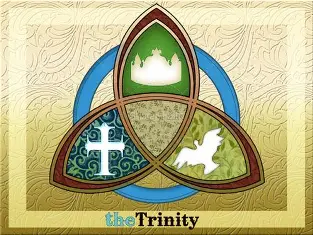
I wear these earrings my husband gave me from Ireland a few years ago every Sunday to bring a symbol of Trinitarian love and delight with me to the altar as a reminder that we are woven into the divine mystery and love of God. The Trinity Knot, or Triquetra, is a three-cornered knot symbolizing unity and eternity in Celtic culture. There is an example of it on the back of your bulletin.
The knot is composed of three interlocking loops, often associated with the natural elements of earth, water, and sky. As Christianity spread, it was not a far stretch for Celtic Christians to come to understand it as also representing the Holy Trinity: the Father, the Son, and the Holy Spirit, as God was in all of God’s creation. The Trinity Knot was a symbol of life, death, and rebirth, which is very much our understanding of the Incarnation and Resurrection of the Christ. It is often associated with themes of love and unity, with its continuous, unbroken design representing eternal love and the unending bond between the Trinity and its love with us and all of creation.
Julian of Norwich, a 14th century theologian, wrote about this theology in her book, “A Revelation of Love,” the first written by a woman in the English language. Love was the most important theme in God’s revelation to us about the Godhead, the three-in-one, and the second most important was “delight.” If one were to study the life of Julian, you would not conclude that she would become a Christian theologian of love and delight. Her life was riddled with pain and sorrow. A plague had spread through Norwich when she was a child which killed 75% of its inhabitants. They had no vaccines then. As a young adult, another wave went through and killed 75% of the children. We don’t know if she lost children, but she was part of a community that experienced tremendous suffering and loss.
She then devoted her life to prayer for her community and for 40 years the people would visit her in her cell where she was cloistered in a room off the sanctuary of the church. I have sat in that room and tried to imagine her praying, counseling, and writing the revelations God revealed to her and her interaction with the community. You can feel the prayers still resonating from the original ruins of her space. Before she died she passed her book out of the window of the anchorage and into the hands of people who loved it, copied it, and shared it–which is why we have it today. The Spirit of the Godhead still revealing the truth to the followers of Jesus with surprise and delight.
Revelation of Love turned the whole heavy world of religious obligation–all of its shoulds and have-tos, musts and or-elses–on its head. “Our soul must perform two duties,” she writes. “The one is we must reverently wonder and be surprised. The other is we must gently let go and let be, always delighting in God. Think about that–wonder and surprise–duties of the soul. Letting go (of what we can’t control) and delighting in God. Julian is right: delight, surprise, and wonder are spiritual disciplines. The poet Ross Gay agrees. “When I say joy is a discipline, I mean it’s something that needs to be practiced, like [basketball] shots and grafting [roses.]”
Three, in Julian’s understanding, is the most alive of numbers. Not so solitary as one, not so dualistic as two, or as square as four, three is dynamic and ever-changing. In the Trinity, three is continually resolving itself into one and returning again to three. It’s not just a pattern in and of God, it’s also a pattern of the whole created world and us. It is the very foundation of the Incarnation and of the idea that we are made in God’s image. We are [woven in] three in one, just as God is three in one. Bound in an eternal movement of love.
Julian explains it one way:
Our whole life is in three:
First there is the being.
Then the becoming,
finally the fulfilling.
First there is being: the goodness, love, and divine inspiration of our very existence and the existence of all living things. This is the part that Julian associates with God the Creator, and to which she refers in her famous passage about the hazelnut, “All things being because of the love of God” (Chapter 5).
Then there is the goodness, love, and even difficulty of our journey, our travel through this life. She calls this traveling our “becoming” and associates it with God the Son, the Incarnate Word, who walks with us as “our mother, brother, and savior” (Chapter 58).
Finally, there is our fulfilling, the work that is done in us through the inspiration of the Holy Spirit, who is “faithful to complete it” (Phil. 1:6). And the Holy Spirit, especially of all three persons of the Trinity, is the one who, like Wisdom in Proverbs we read today, delights.
Carrying this delight into our daily lives is the challenge of honoring the image of God in ourselves and in each other. My friends, we are not owners of the truth and we are not able to define the Trinity in a way we can truly understand. But we can live in this sacred mystery with delight and love, allowing ourselves to be surprised by joy and playful, for our faith is about our God longing for us, inviting us into the divine family, and noticing our own longing for God. Let us live in wonder and surprise, let go and let be and let the truth of the Father, Son, and Holy Spirit dwell in you to make you whole.
 Magdalena's Musings