
Seventh Sunday of Easter, Year C
Jun 1, 2025, Acts 16:16-34
On our last Sunday before the Pentecost, we have a very interesting account of Paul, Silas, Luke and others who were busy spreading the Good News in towns and villages and what happens when the Gospel of Jesus Christ messes with the powers that enslave and imprison us. Today’s lesson is about salvation and liberation.
Paul, Silas, and Luke who is writing down this account of what happened there, are still in Philippi. It’s important to know a little bit about this colony to understand the full importance of what Luke is telling us about their time there.
Augustus Caesar, you may have heard of him, was the founder of the Roman Empire. It’s a long, sordid tale, but he defeated Cassius, Brutus, Mark Anthony and Cleopatra to become the first Emperor of Rome. Now, he had promised his loyal soldiers that if they stood by him in defeating his opposition, he would give them their own land. And so Philippi became a mini-Rome governed by two military officers, a Roman colony in the middle of a Greek world.
When Paul and his entourage arrived in Philippi a couple of decades later, the established language was Latin and all of the power and wealth was directly connected to Rome and the Roman military – they “owed” their status to Rome and Augustus. Augustus was revered as the Prince of Peace and Most High Son of God. He had a strong association with the God Apollo and credited Apollo with his victory over Marc Anthony and Cleopatra.
It is in this setting that one day Paul and the others head to a place of prayer when a mysterious slave girl starts following them. She is possessed with the spirit of divination, more accurately with the spirit of Pithia. And this spirit is associated with the high priestess to Apollo at the Delphic Temple. On several occasions she shouts out, “These men are slaves of the Most High God, who proclaim to you a way of salvation.” I think you can see why this was going to be a problem.
Paul was troubled by this (a much better translation than annoyed) and after several days of this he turns around and in the name of Jesus Christ casts the spirit out of this slave-girl, whose strange prophetic gift had been used by her owners as a source of wealth. As elsewhere in Acts, once the gospel touches local spiritual powers on the one hand and local economic interests on the other, you can expect fireworks, and we get them.
Now the price of messing with freeing a slave and interfering with how slave owners make their money is high. When Paul cast out the spirit easily, he showed the power of Christ over Apollo. Paul’s apostolic power through Christ was not just over Apollo, but over the Civil religion of Philippi. This nameless slave girl’s proclamation undermines Apollo’s authority by claiming Paul’s God as Most High. In the city that was founded by Caesar Augustus who vehemently claimed the title Son of God for himself.
So, yes, we know how this is going to turn out. Paul and Silas were dragged before the magistrates–now they are looked upon in disdain for their ethnicity and religious beliefs where before it wasn’t a problem. “These men are disturbing our city; they are Jews and are advocating customs that are not lawful for us as Romans to adopt or observe.” They are not one of us,they don’t belong here, they are basically saying, so they stir up a mob and beat them up. Little do they know is that Paul and Silas are actually birthright citizens.
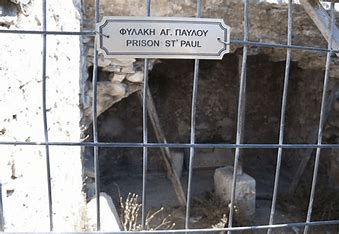
A slave is freed, and suddenly the free men, Paul and Silas, find themselves in prison, shackled as if they were murderers and detained in maximum security. Yet Paul and Silas had a freedom no magistrate or mob could take from them. They are not about to let this injustice done to them steal their joy. And they sing. They have been unfairly beaten up by a mob, bloody, bruised, and in pain and they start singing and praying! And the other prisoners were listening. Lord knows what they were thinking.
The power of a song is something the slaves in this country knew, too. The spirituals we sing in churches today were songs they sang in captivity. Many of these slaves brought with them the belief that songs themselves can heal wounds. There is a Balm in Gilead was sung originally in refugee camps during the Civil War to bring spiritual healing. It is believed that Harriett Tubman and the Underground Railroad used the traditional spiritual Wade in the Water as a way to warn slaves to get into the water to hide their scent from the slave catching dogs on their trail. Prisoners know the power of song and faith. The Gospel is never imprisoned.
It reminds me of Corrie Ten Boom in the Nazi concentration camps reciting bible passages to the other prisoners as they worked. I can only hope there are Corrie Ten Booms in the detention centers across the United States today, and Pauls and Silases who are praying and singing for other prisoners.
Paul and Silas are singing and praying in the midnight hour in prison when there’s an earthquake and all that binds them falls away. And they just keep on praying! Which really surprises the jail keeper who is sure that anyone in their right mind being in prison would leave quickly once the doors were sprung open. But Paul and Silas aren’t going to claim their freedom at the cost of another’s life and they intervene.
“What must I do to be saved?” asked a very grateful jailer. What a complicated question. It’s really hard to divorce our western minds from what salvation has come to mean to the Western church, but in Jewish understanding, and the jailer’s pagan understanding and certainly in Luke’s view of the Gospel, “salvation” wasn’t about “how do I get to heaven.” What he really meant was, ‘Gentlemen, will you please tell me how to get out of this mess?’ When Jesus talked about salvation, he was asking “Do you want to be made well?” Salvation is to be healed, set free, liberated.
N.T. Wright, one of the world’s leading biblical scholars today explained this further, “At no point in the whole book does anyone ever speak, or even sound as though they’re going to speak, of those who follow Jesus following him to heaven. Nobody says, ‘well, he’s gone on before and we’ll go and join him’. And for a very good reason. When the New Testament speaks of God’s kingdom it never, ever, refers to heaven pure and simple. It always refers to God’s kingdom coming on earth as in heaven, as Jesus himself taught us to pray.”
The Good News of the Gospel is indeed to free the slave, and we are slaves to so many things that bind us. Jesus said, “I have come to set the captive free.” The Good News of the Gospel calls the church to participate in speaking truth to these powers in the name of Christ, to be at work in the world to bring healing and freeing the captives.
The point of the whole thing is this. This is what the kingdom of God looks like when it shows up on earth as in heaven. Prayer and testimony bring healing and hope to people, yet as N.T. Wright reminds us again, “the church claims the right, in invoking Jesus as Lord, to challenge the systems of corruption that dehumanize people and enslave them.”
This example of the kingdom of God on earth does not end in a jail cell. Those that experience the liberation of Christ came to believe that Jesus the Christ was indeed the true Son of the Most High God. As we have seen over and over this Easter season, just when we can no longer see past the shadows of death, despair, and captivity, the dawn breaks. Joy shows up and just like Jesus who fed the hungry on a hillside and later was waiting for the hopeless disciples on the shore with a hot breakfast, this jailer, now a new believer in Jesus, binds the wounds of Paul and Silas, and you guessed it, sat them down at his table with his family and fed them a meal. This is still what happens when we make real the kingdom of God on earth. Living the Gospel in the world today will come at a cost. Yet when we walk into this church we are all hoping to find the love that heals our wounds and mends our broken hearts. We come to be set free from what imprisons us and to gather around this table in our brokenness to offer our thanks.
Paul learned that this salvation was offered to everyone and all of God’s creation when he later wrote to the Galatians, “There is now no longer Jew or Greek; there is no longer slave or free; there is no longer male and female, for all of you are one in Christ Jesus.” May we always be the healing and liberation of Jesus Christ the Most High Son of God for the Gospel is never imprisoned. May Christ put salve on your wounds and give you a song in your heart that sings even in the direst of circumstances, for we sing together, not alone.
 Magdalena's Musings