
Easter Sunday, Year C
April 20, 2025
Alleluia! Christ is Risen!
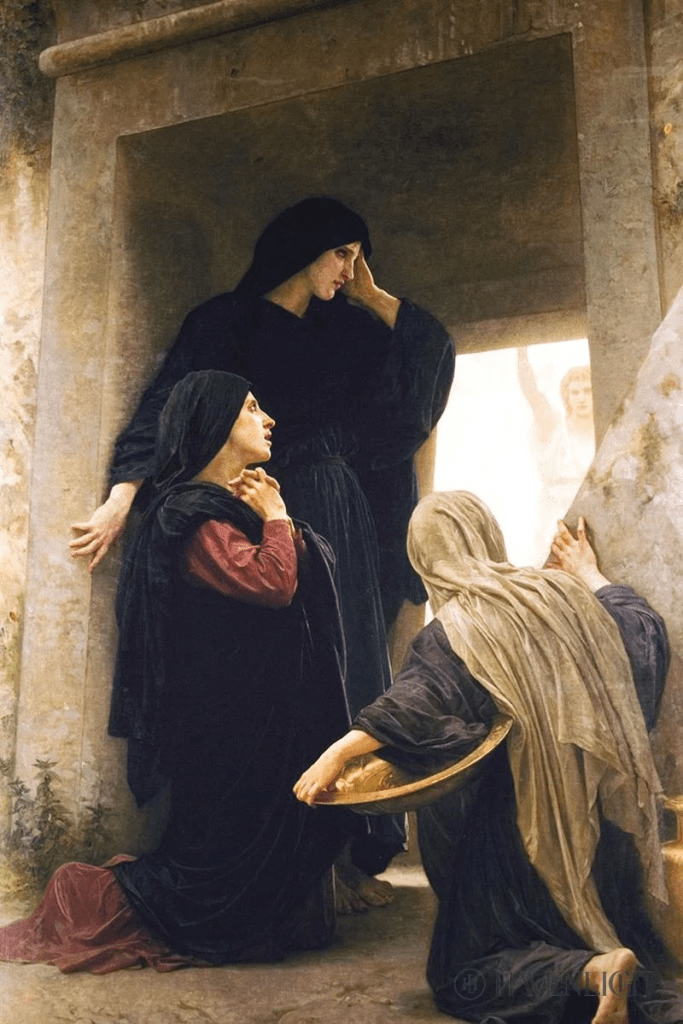
What a week we have remembered. From Palm Sunday to this joyful Easter morning we have walked a path from cries of hosanna (which means save us!) to sorrow to unbelievable joy. If it feels like whiplash, can you imagine what the followers of Jesus experienced? It is no wonder then that these women who showed up at the tomb that morning were having a bit of difficulty processing what they saw, or more importantly, what they didn’t see.
Three of these women are named by Luke as Mary Magdalene, Joanna, and Mary the mother of James, but he also mentions there were other women. The other Gospels also name Salome, Mary of Bethany, and Mary, Jesus’ mother, who all bore witness to the crucifixion and resurrection. The women’s prominence in the Gospels, both named and unnamed, is significant for they are the first to see and hear, to testify and proclaim the Resurrection. It was not any of the twelve apostles.
When they arrived at the tomb and saw the stone rolled away, that was startling enough. But they enter still expecting to find the body they came to tend. And it’s not there. And if that wasn’t enough, everything they understood was turned upside down when two men, so illuminated that they were dazzling to the eyes, ask them why they are looking for the dead among the living. “He is not here,” they explain, “but has risen.” And probably sensing their bewilderment, these dazzling young men, whom Luke later calls angels, instruct them to remember–remember what Jesus told you in Galilee? Capernaum in Galilee had been Jesus’ home base and the area where most of Jesus’ teaching ministry took place. While now they all find themselves in Jerusalem, most of what Jesus taught, explained, and told them would happen occurred while they were in Galilee which was not a super popular place.
But hearing something you don’t quite understand at the time doesn’t mean that when you witness it, it suddenly makes sense. At first they were perplexed, and then became terrified when these bright strangers started talking to them. I mean, who are these people and where is Jesus? They have been through enough trauma already this past week and all they wanted to do was remain faithful, fulfill their obligation as soon as the Passover had ended, to prepare Jesus for burial. It was a final act of love on their part–to lovingly care for the body of the one that had been taken from them so cruelly. And even that was being denied them.
At a time when it seemed as if the cruel forces of a powerful and oppressive government had won, when evil had appeared to triumph over good, the women still acted with the only thing they knew to do in the moment. They went to the grave. They were looking for the dead because death is what they knew and we all know–most of us have experienced the loss of someone we love–we know that sorrow. What they didn’t recognize was Life, Resurrection. So when these women are asked, “Why are you looking for the living among the dead?” it was incomprehensible, despite Jesus’ having told them ahead of time. Not until these angel figures told them to remember did the past three years come into sharper focus.
The dawning of comprehension must have been on their faces, in their hearts, and even felt in their own bodies. Holy Moses! This Jesus, he really meant it–the unbelievable, the impossible. And of course, they went back and told the apostles and everyone else. These women, Mary Magdalene, Joanna, and Mary were the first preachers of the fulfillment of the Law–what later became the Christian tradition. So of course, no one believed them. See, no one had seen Jesus yet, just an empty tomb. The proclamation of the women was just a bunch of bunk as far as the others were concerned.
Peter alone goes back to see for himself, but possibly bearing the weight of his denial of Jesus in the final hours, he doesn’t really do anything with what he saw. He goes home amazed but needs some time to process this. We all process differently what we can’t fully understand as we will see in the next 50 days of Easter when his followers actually do encounter Jesus–and they are also very slow to comprehend until they are asked to remember. Remember what he told us? Remember when we witnessed his actions? Remember when he stood up for the adulterer? Remember when he defended the poor? Remember when he healed an untouchable woman? Remember when he ate with those vile tax collectors? Remember when he sat with those from other religions and races? Remember when he fraternized with our enemies? Remember his quiet power of resistance? Remember when he flipped those tables? Remember when he told us to put away our swords? Remember when he said he’d have to die? Remember when he said he’d rise in three days? Remember?
The dazzling young beings the women encounter in the empty tomb are the ones who point them to remember. The women are the ones who make meaning of both the memories and the emptiness of the tomb. These women are the ones who, though fearful that morning, connect all the dots of their experience and their discipleship in Galilee with their discovery in the tomb.
These women not only proclaim resurrection hope but translate that hope into future action and initiate continuity in the community. These women were the ones who did this intellectual, emotional, and social labor that brought the disciples of Jesus–who had scattered in fear–back together to remember, to work out their understanding from the experiences of the past few years with Jesus, and then to act as proclaimers of the Good News. Not only is the power of this God greater than the evil that tried to kill it, it conquered death.1
Here is the crux of the Easter message. In our Eucharist liturgy today, we proclaim this mystery of faith together as a community: “Christ has died. Christ is risen. Christ will come again.” In the depths of that mystery lies a kind of fullness of human experience, too: Grief. Joy. Anticipation. Hope.
When I worked for Compassion International I had the wonderful privilege of working with a minister in the inner city, Vincent. Vincent died at age 41 from cancer but he managed to touch the lives of gang members and share the hope of love, resurrection, and life with them. He stared every day at the ravages of what poverty does to a community, especially its young people. We walked through places together where young men and women thought their only future was to die by violence. This man who saw the shadows of despair every day used to tell me, a white woman of privilege, “Sister, never let ‘em steal your joy!” Twenty-five years later his voice keeps reminding me. He loved with the love of Jesus every single person he met. No one was beyond the reach of God’s love. In my eyes, he was Jesus walking through the slums of Chicago.
At a time when Joy and Hope may feel too far of a stretch for those who are afraid, angry, confused, and helpless and the presence of evil and oppression feel overwhelming, let us remember with Mary Magdalene, Joanna, Mary the mother of James, Peter, and the apostles and followers of Jesus, even if all one can see at this moment is an empty tomb. Let us remember that love is stronger than fear, that true joy cannot be taken from you without your permission, and that courage to stand against evil is where we find our hope. We can proclaim the words that have echoed down through the ages and still are heard today on this Easter morning, “Where, O death, is your victory? Where, O hell, is your sting?” 2Love, resurrection, and life is our foundation and are to be found among the living.
My friends, the Easter message is the hope of liberation and restoration for all. Like these women, the angels also invite us to remember. Remember that Jesus fed and washed the feet of Judas, too. That Jesus hung on a cross with a criminal whom he welcomed into His kingdom, and the message of liberation and resurrection came through the very people, Jewish women under the oppression of the Empire, whose society had deemed invalid witnesses.
As we proclaim the resurrection in our own time and place, let us always remember that the kingdom of God is revealed to us most clearly by those who are dispossessed by the powers and principalities of this world. Let us celebrate the joy of Easter by seeking and serving the resurrected Christ in the lives and the witness of those who have been silenced, persecuted, and marginalized.3 Remember that true power is in Love. Never let ’em steal your joy! Alleluia! Christ is risen!
- Katherine A. Shaner. https://www.workingpreacher.org/commentaries/narrative-lectionary/resurrection-3/commentary-on-luke-241-12-11 ↩︎
- 1 Corinthians 15:55 ↩︎
- https://episcopalnewsservice.org/2025/04/19/presiding-bishop-sean-rowes-2025-easter-message/ ↩︎
 Magdalena's Musings