
Lent V, Year C
April 6. 2025
This Sunday we take a break from the Gospel of Luke and visit the Gospel of John. It is the account of a woman, and in this case specifically Mary of Bethany, who anoints Jesus with oil. Such an important event that all four Gospels have a version of this incident with slight variations. In Mark, the story concludes with Jesus’ statement that “wherever the gospel is preached in the whole world, what she has done will be told in memory of her” (Mark 14:9). We will look at this Gospel passage today in memory of Mary of Bethany.
So who was Mary of Bethany? Why was this memory so significant that all four Gospels would tell it and we would recall it centuries later? There are so many Mary’s from the Gospels that too often we conflate them into one or two people but Mary was a very common name in the Jewish tradition deriving from Miriam, the name of Moses’ sister.
It helps to give context to John’s account here. In Matthew and Mark, she remains unnamed, and in Luke, it’s ambiguous as to which Mary he is referring to. But John is very specific about who she is. She is Mary, the sister of Lazarus and Martha, quite possibly a family whom Jesus would call his best friends. Jesus just recently had raised Lazarus from the dead and had wept at his friend’s tomb. The first resurrection story and a prelude to what was coming.
The resurrection of Lazarus was the final straw for many of the religious leaders who were keeping an eye on Jesus. This is the point when they first decide they want Lazarus really dead, and then decide it really must be Jesus they are going to have to get rid of. The hostility had grown so great after Lazarus came out of the tomb alive and the growing number of followers Jesus was acquiring that Jesus and his disciples had to head back out to the wilderness for safety as the authorities were now after him. In order for the leaders to keep their power and position, they knew they had to get rid of Jesus. He would be rounded up by the soldiers later, but not yet.
Then Jesus decided to return to Bethany six days before the Passover to the house of his close friends, probably for the intimacy and consolation that only close friends can provide when one is under a lot of pressure and anxiety. Mary, Martha, and Lazarus in Bethany were providing a safe place for him, a sanctuary of sorts. The atmosphere would have been tense as his disciples, followers, and friends did not want him returning to Jerusalem although he was determined to do so. They knew he was walking into trouble. As a devout Jew, the religious leaders were banking on Jesus going to Jerusalem for the Passover. So you might imagine that the mood may have been a bit grim around that dinner table that evening.
So here they are all sitting around the table and I imagine some of them are still trying to talk Jesus out of his plan. You see, their movement was gaining momentum. With Jesus at the helm whom they were beginning to believe was perhaps the Messiah, they were hoping to take up arms and kick the empire out of their land. If Jesus were to head into Jerusalem now, with the patrol out to get him, he could get arrested and thrown into detention upending all their plans for an uprising.
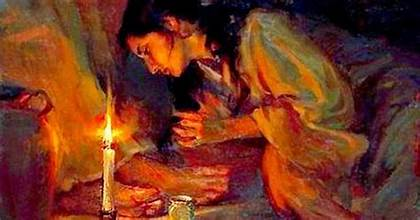
Amidst this backdrop, Mary walks in the room, kneels at Jesus’ feet and breaks open her bottle of pure nard halting all conversation. And she proceeds to anoint Jesus’ feet with this oil, all of it, to the dismay of the onlookers. And then tenderly, with the same relentless affection she has watched Jesus bestow on her, the disciples, and all who have come to him–the poor, the stranger, the outcast, she wipes the oil with her hair. Both she and Jesus would have carried this aroma all the way to the cross.
Andrew McGowan points out that “Anointing in the ancient Mediterranean world was not in itself unusual, but was part of what we might think of as grooming, hygiene, or cosmetics. Oil-based perfumes were the norm and used daily, at least by those whose means and lifestyles made that possible.”
Anointing was also used in rituals, usually as an initiation of those holding high offices. Mostly we hear about the head being anointed but in John’s Gospel it is Jesus’ feet. This should probably be understood first and foremost as a more elaborate version of the typical foot-washing offered to guests; to follow any form of washing with perfume was not in itself remarkable, although perhaps reserved for a distinguished guest and the strong scent would still have remained.
What was remarkable was the use of her hair. It was an unusual and deeply intimate act. Mary here is not a penitent sinner but one who was deeply devoted to Jesus and she is making a complete self-offering by using her very expensive oil. And not just some of it, but all of it. Jesus knows what this act really means. How much she truly realized what she was doing we don’t know, but she was preparing him for burial. And he knew it.
Mary’s gift was one of massive value and Judas’ reaction to it is too often what well-meaning Christians surmise as well. Her gift could have been sold and used for the poor, if she was just going to pour it all over Jesus’ feet and the floor for heaven’s sake. But it’s important for us to take a closer look at what Judas’ comment was really about and what Jesus really meant when he replied, “The poor will always be with you.” Unfortunately, too may have reduced this retort to justify not taking care of the poor because it won’t matter any way. That is not at all what Jesus is saying here, and one would do well to read all of the Gospels to realize without question that one of Jesus’ primary concerns is always for the poor.
But Judas wants Mary to use her gift for the poor, not his discretionary account, even though he was the one in charge of the purse for the whole gang. But this was her gift for Jesus, and it is her choice that determines how the valuable gift will be used, not Jesus’ or Judas’. So Jesus is telling Judas, leave her alone. The poor will always be here and if you’re so concerned about why and how she is making this offering, then why aren’t you doing something for the poor instead of criticizing how she is honoring me.
Judas will always have the poor among him because he does not share what he has, but seeks only for himself. Mary offers radical service, love, and devotion and Judas offers nothing but is wrapped up in self interest, his own motivations, and doubt. It’s not a case of either “care for the poor” or “offer a gift of devotion.” It is to care for the poor AND offer a gift to God when the Spirit of gratitude moves you to do so. Jesus was not always going to be with them in physical form, but the poor were and will continue to need to be cared for.
I also want to point out that both Mary and Martha offer a gift to Jesus. They both seem to already know they serve a king not of this world. Mary, offers her expensive nard and anoints Jesus. Martha offers a gift of preparing a meal for these hungry disciples and their Teacher as they’ve just come in from the desert where they’ve been avoiding being rounded up by the authorities. Both of these women tend to Jesus’ needs–practical feeding for the weary body and devoted care for a weary soul.
This was a symbolic act by Mary, also recognizing Jesus’ royalty because on the next day, which we will celebrate next Sunday, Jesus will ride into Jerusalem on a donkey as a King. What those that mock him as king, and what Pilate and others will fail to see, Mary acknowledges. We remember her choices throughout the ages because we are to acknowledge Jesus in much the same way with extravagant love and devotion. Remember the extravagance of the Prodigal Father from last week?
While Mary anoints Jesus and prepares him for what is to come, Jesus’ response to Judas’ greed and short-sightedness was to also remind that we inherit a responsibility for the poor once Jesus is gone. As we will see in the coming days, Judas’ (and others) disappointment in Jesus that his reign as king was not by violence or force, but of love and self-offering, provokes them to turn their backs on this kind of kingdom. Mary’s gift is a foreshadowing of the extravagant gift of Jesus’ own life, and we are invited to offer a gift of devotion with equal lavishness. Could Jesus still smell the remaining scent of the nard Mary had poured on him as he lay dying on the cross–a sign that there was someone that had understood and cared enough to tend to him?
Like the abundant flowers we provide on Easter Morning and the additional musicians we bring in to celebrate the Resurrection, we show our love and devotion by creating the beauty of holiness, as well as still caring for the poor as we have been instructed to do by the one we serve. Even in times of scarcity we can still contemplate allowing ourselves to become drawn so close to Christ that it elicits a response of love so deep that we lavishly pour out all that we are as a gift to honor the Lord of Love.
In the coming week may we ponder these questions. What will Holy Week mean to you? Whether your love language is a Mary or a Martha, how will you prepare to walk into Jerusalem with Jesus and stay near him in his passion? Will you, like the women, not abandon him at the cross? What is the gift of love you have to offer, that is yours and yours alone to do with as you desire.
Let me close with this prayer from Gertrude the Great, who, like Mary, loved Jesus with all her heart and soul and mind:
O Love, O God who created me,
in your love recreate me.
O Love, who redeemed me,
fill up in me whatever part of your love
has fallen into neglect within me.
O Love, O God, who first loved me,
grant that with my whole heart,
and with my whole soul,
and with my whole strength,
I may love you.
 Magdalena's Musings