
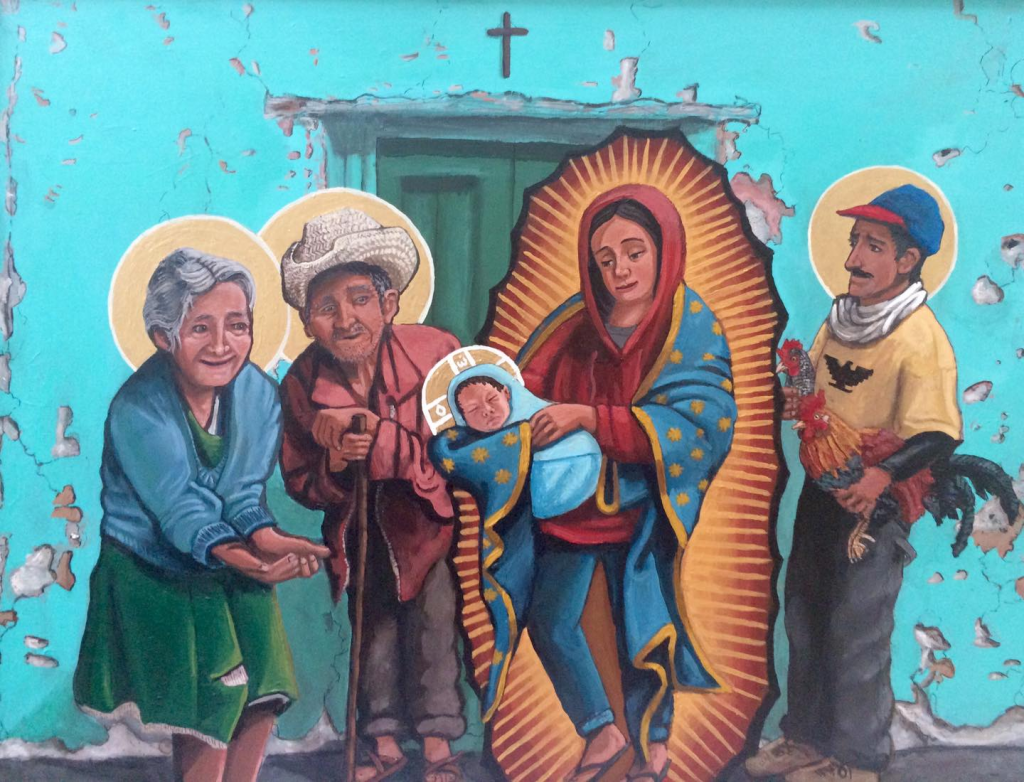
The Presentation of Our Lord
Feb. 2 2025
Luke 2:22-40
Every culture has traditions and customs surrounding the birth of a baby. In China, Red-dyed eggs and pickled ginger are prepared and shared with family and friends when a baby is one month old to symbolize luck, happiness, and good fortune. In Finland, the new mother is cared for by others. She is given a food basket that includes staples such as cheese, butter, meats, pastries, eggs, milk, aiming to strengthen and support the mother. The Navajo celebrate a baby’s first laugh. The first laugh is seen as a sign of the baby’s desire to leave the spirit world and join her earthly family and community. In our Gospel today, we find two other rituals practiced by a young Jewish couple who have made their way to the Temple in Jerusalem for a purification rite of a new mother and the tradition of presenting and dedicating the firstborn son to God. Mother and child in the Temple of God and little did those parents know that they had just brought the very Son of God into his own dwelling place, their baby already dedicated to God.
The first time Jesus comes to the earthly Temple of God, he comes as a baby to partake in the ritual that had been established by Moses–”Every firstborn male shall be designated as holy to the Lord.” The irony is this Lord is the very God to whom Jesus will later call Father, Abba, when he is an adult. His parents already knew that Jesus was holy to the Lord, they may not have understood yet that this child was God. Yet the ritual they were participating was still important, a ritual that had been carried out for generations.
One may question why making the considerable effort to do so was even necessary. Why would the Mother of God, the one who bore the Savior of the world need ritual purification? And why would the Redeemer of the World need redemption? Luke is painting a picture for us of how this little family remained devoted to the rituals, the acting out of their faith. Jesus, who will later tell us that he did not come to abolish the law but to fulfill it, is already doing so even as an infant.
Why did and do these rituals matter? Why did Mary and Joseph and Jesus stay faithful to the ritual requirements of the Hebrew scriptures? Why does it matter that we attend to our rituals, especially our sacred rituals, and come to church each Sunday and kneel and stand and repeat the same words we said the week before? A lot of people think it doesn’t matter, preferring entertainment, some even think it is silly. You see, the ritual is the connecting tissue of faith and understanding. It embraces all the senses, smell, taste, sight, sound, and touch. All the ways a person learns and it becomes muscle memory.
Anthropologists, social scientists, religious scholars, and psychologists have studied the mystery of why human beings respond as they do to ritual and why it matters. From brushing your teeth every day to celebrating the Eucharist to walking on fire, ritual plays an incredibly important role in our lives and our communities even when they seem meaningless.
For example, anthropologist Dimitris Xygalatas published his research in a book titled, “Ritual: How Seemingly Senseless Acts Make Life Worth Living,” and discovered that “in the context of a fire walking ritual in Spain, we found that during this ritual, people’s heart rates synchronized. This was not just an effect of people moving at the same time. Their heart rates would synchronize no matter what they were doing at the same time. Some of them were walking on fire. Others were watching. And that shows that these rituals play a role in bringing the emotional reactions of the members of that community in alignment. And by aligning our appearances, aligning our motions, aligning our emotions, those rituals can actually lead to social alignment.”
Mary and Joseph, Simeon and Anna, may not have been able to explain why the rituals they adhered to and performed over and over mattered, but they knew they did. A young mother and her baby, giving the offering of the poor who could not afford a lamb, was a ritual they nevertheless valued was important enough to travel to Jerusalem for forty days after Jesus’ birth. They believed it mattered.
Simeon and Anna had served in that Temple looking for hope in a time when their people were oppressed, kept in poverty, and often brutally treated by the Roman government. Anna spent a majority of her 84 years never leaving the Temple, praying every single day for the redemption of Israel. I have no doubt that many people criticised or laughed at her for being so ridiculous. Members of her family probably thought she was delusional or at best, tolerated her beliefs as the cute religious piety of an old woman.
But it meant something, and Anna may not have been able to explain what this ritual did for her and others, but she was faithful to her calling for at least sixty years or more. And in case you doubt that your prayers matter, Luke wants us to know that God heard the prayers of an 84 year old widow. She was present when Jesus entered the Temple for the first time and Anna knew the Redeemer as soon as she saw him. The rituals she had by now ingrained into her very cells set her whole being in alignment with God and she knew. Did the people hear her prayer change to one of jubilation? Did they notice what she was saying and announcing? How many people 33 years later after Jesus rose from the dead remembered Anna, the daughter of Phanuel, of the tribe of Asher and her prophecy? Some most have taken notice because several years later when Luke wrote his Gospel, he called her a prophet. The world has known her ever since as the one who announced in the Temple that the Messiah had come to all who were looking for redemption.
And Simeon. He wasn’t anyone of special notoriety. But he was clearly a man who kept to his ritual of prayer and devotion. Christian scholars in ancient times assumed that Simeon was a priest serving in the Temple, but Luke merely says that he was a devout and righteous man living in Jerusalem. Simeon was living in expectation of the coming of the Messiah, and Luke tells us that he was led by the Holy Spirit to come to the Temple on the day that Jesus was presented. The Holy Spirit had told him he would not die before he saw the Savior. Did his friends and family think he was just eccentric? He prayed for the consolation of Israel without ceasing which over time made him aware of the Spirit’s guidance and presence.
Had people dismissed him as a pollyanna, a silly old man who blindly believed in a God that didn’t seem to hear the cries of the people? His rituals, too, kept his faith alive when it seemed to others that faith ceased to matter. Yet because of his faithfulness to the ritual of prayer, he also knew when he had seen the Savior. Simeon wasn’t a priest, he wasn’t a scribe, just an ordinary man in his old age who never gave up on God and prayer. When Jesus showed up on earth, it was not a golden era for the Jewish people, either. Luke will really be reminding us all year that Jesus purposefully came among the poor and valued the inconsequential.
All societies have their rituals. Research across academic and social methodologies reveal that rituals are essential for ordering our families, friendships, work, play, and personal lives. They help form our identities, both individually and communally. Rituals are how we pass on wisdom and beliefs across generations.
The important ingredient in participating in rituals, whether family traditions or religious gatherings, is how we choose to participate. How we show up makes all the difference. Choosing to be mindful and fully present means that we will both receive the most from and give the most to the experience.
For two thousand years the rituals surrounding the life, death, resurrection, and ascension of that baby that showed up in the Temple with his humble parents, still matters. Luke emphasizes throughout his Gospel the importance of those bearing witness to their faith, always giving voice to those considered irrelevant. Luke highlights the fact that a faithful man who was not an educated priest, but faithful to his devotion and prayer, was the one that blessed Jesus that day. Anna, an old widow, a status that could not have been much lower in that culture and society at the time, became the prophet announcing the Redeemer of the world. They showed up and they participated fully in the sacred rites of their faith.
What we do here every week at St. Christopher’s also matters despite the times of darkness and despair for many. The rituals we perform to worship God, love each other and our neighbors, matters because we fully embody the mystery of faith. The parts that are inexplicable. Like those who go so far as to walk on fire, our hearts, too, can synchronize as one. It takes our commitment and dedication to the practice of our faith. For those who cannot make it every week, we carry them with us, holding the whole body of faith together as one at St. Christopher’s.
Taking the body of Christ, the bread of heaven into our hands, sharing in one cup of wine, the blood of Christ, giving yourself as an offering to God and joining as one in the prayers of the people. Through these practices celebrated together, the Holy Spirit soothes our hearts, binds us as one, and reassures us of the promise that we are God’s beloved. The Kingdom of Heaven draws near. Like Simeon and Anna, do not lose heart. Something is happening even when we doubt, a cord that connects us all as we rise and kneel, sing and pray, receive and give without ceasing. This is how God binds us together, with cords that cannot be broken.
 Magdalena's Musings