
3rd Sunday after the Epiphany
1 Corinthians 12:12-31a
Luke 4:14-21
Why do you think people come to the church? What is it they are looking for? Why did you come? Why did you stay? After one year of being with this wonderful congregation, I have heard from enough of you to surmise that you came looking for a community, a place to belong, folks that would love and support you, hoping the church would be a safe place of acceptance because life had been a little rough at times. And perhaps you or they chose the church because of the inner desire to find that something that was greater than yourself, that held all things together, had a reputation for love, and that maybe this Jesus Christ was at the center of what held the community together because, this was a bit different than a bar or social club.
And hopefully more times than not, they and you did indeed find these Christians were doing their best to live out the love that they professed. And it was that, rather than a social club, that anchored you. You may have noticed that sometimes they missed the mark, but the intention was to welcome and to love and to respect the dignity of every human being. And so you and they wanted to know more about this Jesus Christ and why different people would dare to come together to worship this God. You may have noticed an interdependency amongst the gathered, they could fulfill their mission when they did so together. So, you embarked on a journey to know that more and more deeply for yourself. How to be a Christian in a committed community.
There has to be something that holds this hodge podge group of people together that have different opinions, different life experiences, different backgrounds, and different ideas of how to decorate the parish hall. But there is something that transcends these differences and becomes the most important reason we agree to live in unity, and that is becoming the Body of Christ, to love God and each other. Because at some point we get the message of this Jesus that deep down in our hearts and souls we belong to Christ first and foremost, and therefore we belong to each other. Our adoption as the children of God is more important than any other claim we make on who we are, more important than our political parties, more important than our ethnicity, more important than our gender or nationality because we have come to really understand, as difficult as it may be to truly embrace, the words of Paul today, “For in the one Spirit we were all baptized into one body–Jews or Greeks, slaves or free–and we were all made to drink of one Spirit.” In another letter to the Galatians Paul wrote, “There is neither Jew nor Greek, there is neither slave nor free, there is neither male nor female; for you are all one in Christ Jesus.” It was a message that Paul repeated over and over to the various churches. Despite the categories others place you in, you are one in Christ, God’s own beloved. And no matter who walks through our doors, they walk through as a child of God, needing our love, needing our support, needing the loving acceptance of a community where they are safe and cared for. We welcome the stranger. We embody the prophetic words from the scriptures, “What does the Lord require of you but to do justice and to love kindness and to walk humbly with your God?” Micah 6:8
And for those too afraid to walk through that door we follow the example of our Savior Jesus, and we go to them. Sharing the Good News that God finds them worthy and calls them by name. The Good News is that the love of Christ will bring freedom to those held captive, held captive by addiction, held captive by fear and hate, separated from their families, held captive by the words from others that they are unworthy.
To demonstrate this love, we welcome them in and we break bread together. We share the same cup. We remember Paul’s words in his letter to the Corinthians that what some may find to be the inferior parts of this Body, God honors. Because we believe by our baptismal vows that we are called to respect the dignity of every human being, immigrant, police officers, LGBTQ folks, those with disabilities, the aged, the young, black, brown, and white, and the list could go on. Because we all belong to Christ and we are anchored in God’s Love.
The Body of Christ does not operate like other groups, businesses, or governments. Every single member is an important part of this body even if they seem like they have a lesser function, or can’t really be seen, or are not really sure why they should be in the body at all. God gives greater honor to what we often call the inferior part. And the body is not whole if a part is missing. And we are missing body parts.
“In God’s kingdom there are no “those people.”
And since we are left here to work for the building of God’s kingdom as Christ’s hands and feet, his Body on earth, we are to continue the work of Christ in proclaiming Good News to the poor, the captive, and the oppressed. For two thousand years that was and continues to be the ongoing mission. It is quite literally the mandate of our Savior himself.
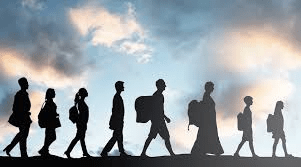
You see, Jesus was born to a poor unwed mother, and as a child knew what it was to be a refugee and have to flee to another country for safety. In fact, quite a few Jews fled to Egypt to find work, to save their children, and to escape persecution. There was a significant Jewish population already in Egypt when Jesus was born as many had fled Roman oppression. God incarnate upon the earth enduring the suffering of God’s people. Welcoming the stranger was therefore at the heart of Jesus’ teaching. Jesus reminded the religious that the path to eternal life was to show compassion to a stranger left on the side of the road needing care, food, and healing. Who will sit and eat with outcasts and know their names because in God’s kingdom there are no “those people.”
From the start this is woven into our baptismal vow–to respect the dignity of every human being. That vow challenges us to look at how we talk about each other and our neighbors. That includes how we talk about ourselves, too. Words matter. We have learned a long time ago that the old playground jingle of “sticks and stones may break my bones but words can never hurt me,” is, as a matter of fact, not true. Words do hurt us. And I think everyone here today can recall a time when words hurt very much and many of you may even still carry scars from the words said in school, at home, and even by the ones we love. We all have said words we regret because they have caused harm.
So for the Christian, we may not agree on partisan politics, we may not agree about what is most important for our communities and families, and we certainly don’t agree on where the best BBQ is in Texas (although we might say it is the men’s group at St. Christopher’s!) But there are some non-negotiables when it comes to our church, like the Gospel of Jesus Christ and our baptismal vows. We have sworn before God and each other that we will uphold the dignity of every human being. You may not like them, you may not understand them–but, as a Christian (and remember that is who you are first and foremost) you have vowed to respect their dignity. And that is true of people new to this country looking for refuge and true of our LGBTQ neighbors, as well. Paul uses the metaphor of a body, and the head can’t say to the foot, you don’t matter. The eye can’t say to the ear, you are worthless. For we all matter. The words we use for each other can cause lasting harm and can even endanger lives.
Words are so powerful that the Gospel writer, John, points out that it was the words God spoke that created the world. Jesus was the Word, the most powerful word spoken to us. So be careful of the words you speak that exit your mouth as sound waves which ripple on and on for a long time and reach spaces you wouldn’t believe before they die out. Are they words worthy of the building up of the kingdom of God?
As we begin this new year together, we need to stay focused on who we are and whose we are. We are to focus on being a place that looks like Jesus and never take our eyes off of the Gospel. That wasn’t easy for Jesus’ first disciples and it won’t be easy for us. The world and all its fear and anger dominates every corner of our lives, so it is incredibly important that we remember that we are to be a light to all–like a beacon for those lost in a storm. We must commit to lives of prayer, service, worship, formation, and be proclaimers of the Gospel by how we live our lives and how we use our words.
It does not matter if you see this time as the Apocalypse or the Golden Age, our work remains the same, to love God, love each other, and ease as much suffering as possible for our neighbors, especially those who are afraid and in need. This Body of Christ is called to shine a light to our community and neighbors, and recognize each member as worthy and valid in our midst. To respect the dignity of everyone, no matter who they are, and to reach out to offer care and love, being Christ to each one. Keep your eyes on God’s Kingdom, my friends, not the kingdoms of this world. Know your worth and everyone’s worth in this Body of Christ.
 Magdalena's Musings