
Advent 4, Year C
Dec. 22, 2024
Luke 1:39-45(46-55)
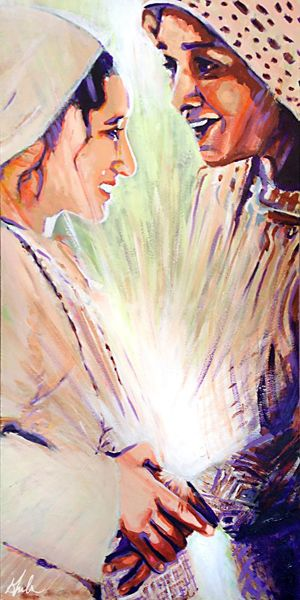
We are getting so close to Christmas–but not yet! It’s almost like waiting for the Second Coming of Christ. It’s here, but not fully. And today we encounter two pregnant women, pregnant with sons who will enter the world and turn it on its head, but not quite yet.
Mary has just been visited by an angel of the Lord who tells her she is going to bear a son. Not just any son, but the Holy One who will be called the Son of God. Mary accepts this message, but she isn’t about to sit around by herself. She takes off in haste, eagerly, is the full translation, and seeks support and companionship in this strange time from the other woman the angel tells her about, a relative named Elizabeth.
Mary goes by foot–about 80 miles–to seek out Elizabeth. Nazareth in Galilee is not close to the region of Judea. It had to take her at least 3-4 days to get there. It would have been too dangerous to go alone, but we don’t know if anyone accompanied her, but she went, nonetheless. God was doing a strange and mysterious thing and the only other person that was in the same extraordinary position and who would understand, was Elizabeth. Instead of wallowing around in a self-interested focus only coming to her own conclusions, Mary sought out companionship. They would not have been able to see what God was doing in each other’s lives, the brimming humanity and divinity in a shared experience of the Holy, unless shared with one another. A great example of how we are to grow in understanding and faith.
It’s interesting that later on in Jesus’ ministry he sends his disciples out two-by-two to bear witness. But that was a pattern already established by God. These two unexpectedly pregnant women hint at the friendship of Naomi and Ruth who set out on a risky journey in support of one another. One is old and one is young. Ruth bears a son who turns out to be the grandfather of King David. Both Elizabeth and Mary are also about to bring new life into the world. One child will mark the end of an age, the other will usher in a new age, the age of the New Covenant. The one that is older , John, will serve the one that is younger, Jesus, mirroring the stories of Jacob and Esau.
And although Luke does not explicitly point it out, Mary appears to be compared to the Ark of the Covenant because the comparisons are too numerous to be coincidental.1 The orthodox Church has long taught this correlation.
The power of the Lord overshadowed Mary at the conception of Jesus and it is the same verb–overshadowed– used in Exodus to describe the overshadowing of the Ark with the Divine Presence. Like the Ark of the Old Covenant, Mary’s body carries the New Covenant and becomes the new dwelling place of God on earth.
David remarked when the Ark came to Jerusalem, “How can the Ark of the Lord come to me?” And Elizabeth said, “And why has this happened to me, that the mother of my Lord comes to me?” Both David and Elizabeth were in awe that the Bearer of the Divine Presence would come to them. And when David did encounter the Divine Presence, he shouted with joy. As did Elizabeth when the Living Ark, Mary, came to her–shouting with a great yell, a cry of spontaneous ecstasy. David leaped and danced in the presence of the Lord, as did John in Elizabeth’s womb at the presence of the Lord in the God-Bearer. It’s also notable that the Ark stayed three months in the house of Obed-edom before going to Jerusalem and Mary stayed three months with Elizabeth before returning home.
There are patterns in the story of God, a message that is repeated, a fulfillment of the Torah in the New Covenant. We would do well to notice these patterns. It’s how we learn to notice the ongoing story of God.
The contrast with Mary and Elizabeth, although Luke says they are related, is striking. Elizabeth is privileged. She is from the line of Aaron, is described as righteous, lives in Jerusalem, and is married to a priest. She has status in her community, and the disgrace she carried in that culture as a barren woman, has now been removed. Mary, on the other hand, is young. She is a descendant of no one worth mentioning. She is not described as righteous or blameless, she lives in Nazareth (can anything good come from Nazareth?), she is unmarried, and her pregnancy lowers her status and will most likely lead to her being socially marginalized and ostracized by her community, if not exiled or stoned to death. That could also be another reason she sought out the support of Elizabeth.
It is the Holy Spirit that began this work in Mary and Elizabeth. We already know that Elizabeth was a woman of prayer and whose faith kept her going even in the many years of shame that she endured. Prayer, worship, and hearing the Scriptures kept their hearts ripe for the Spirit to stir in them and for them to recognize the movement of the Spirit and be guided, to go along in faith with something so outrageous.
We know a lot more about Elizabeth’s faith than we do Mary’s. Mary was so young. Faith deepens as we age, even if we stumble on the rocks of life and decide to take another route, love draws us back more often than not. And sometimes, especially when we least expect it, we smack right into God, or at least into something otherworldly that we can’t explain. Like standing on a mountain top and being overcome by the beauty and grandeur of the soaring rocks and the exquisite valleys below. In those moments, you have a sense that you are in the presence of something overwhelming, mysterious. Time is suspended or at least blurs. One is enveloped by an enormous bliss.2
David Brooks wrote about one of his experiences in the New York Times this week, “One morning in April, I was in a crowded subway car underneath 33rd Street and Eighth Avenue in New York. I looked around the car, and I had this shimmering awareness that all the people in it had souls. Each of them had some piece of themselves that had no size, color, weight or shape but that gave them infinite value. The souls around me that day seemed not inert but yearning…”
The art historian Kenneth Clark, who was not religious, had one of these experiences at an Italian church: “I can only say that for a few minutes my whole being was irradiated by a kind of heavenly joy, far more intense than anything I had known before.”
And Mary has such an encounter when she and Elizbeth meet–that sense of exquisite bliss that something is happening that is so much greater than her present circumstances and repercussions of finding herself unexpectedly a poor unwed teenage mother in a culture that would shun her. Mary bursts into a song that comes from the very depth of her soul with an inverse logic to the logic of the world: the Almighty has scattered the proud, brought down the powerful from their thrones, sent the rich away empty. God has shown what God’s power manifest looks like by lifting up the lowly, filling the hungry with good things, and looking with favor on the lowliness of God’s servants. God has shown mercy and remembered the promises that were made.
I wonder when Jesus preached the Beatitudes to crowds during his ministry, if he was echoing the words he heard his mother speak as he was growing up, the words that formed him. Blessed are the pure in heart, blessed are the poor, blessed are they that hunger and thirst for righteousness because the Kingdom of God is theirs.
The song Mary sings is both startling, revolutionary, and astonishingly beautiful. Luke clearly sees Mary as holy and as important to the coming of Christ into the world for Luke writes about her more than any other Evangelist. All of this fascinates and catches my attention as to the people that God seems to see and calls to them to step into a part of what God is doing in the world. The people that God sees aren’t very often noticed by anyone else in the world, even in their own communities. We might call them nobodies. God sees those that are struggling but not sharing that with anyone. God also sees a heart that desires to understand faith and wants to love the God they worship. It’s the intention, not the perfection, that God notices. Good grief, look at the disciples, they were often a bumbling bunch of ragamuffins that struggled to understand, but they didn’t give up on God and they became people of great faith. Their faith points to God, not themselves. Listening to Mary and Elizabeth, to all who put their utter trust in Christ, I have to keep reminding myself that faith is more like falling in love than it is like finding the answer to a complicated question.
The poor and marginalized are known to burst into song in praise of their God, not because they have the answers, but because they love. God chooses Mary to bear the Son of God into the world so that we would come to learn from the poor. So that we can learn to be humble in the greatness of the lowly. So that we can come to the place in our search for faith that we erupt in joy when we stumble into God unexpectedly. This faith is not logical–it is a joyful mystery. I wonder, what is your song?
- Farley, Lawrence R. The Gospel of Luke, pg. 47 ↩︎
- Brooks, David. :The Shock of Faith” New York Times ↩︎
 Magdalena's Musings